In Conversation with Erin Lynn Welsh for 'Wild Kin'

We chat with Erin Lynn Welsh in her Greenpoint studio ahead of her exhibition at Uprise Art to discuss intuition in art, the resilience of nature, and the California landscape. Read the full transcription of our conversation below and watch the video here.

Uprise Art: Who are you?
Erin Lynn Welsh: I’m Erin Lynn Welsh. I am a painter, a set designer, and most importantly, mama to my daughter Zizi.
UA: Where are you from, and where do you currently live and work?
ELW: I grew up outside of Philadelphia in Doylestown, Pennsylvania, and now I live between Brooklyn and Los Angeles.
UA: When did you start developing this work?
ELW: I started focusing on landscapes and florals in my twenties. I'm 41 now, so it's been a long time of exploration in both bodies of work. For the work that I'm going to be showcasing in Wild Kin, it's a continuation of my work about California, specifically within Los Angeles.
I started going to California when I was a teenager to visit my family. So, initially it started with Northern California, which is where my family was living, and I was really drawn to the diversity of the landscape, from the cypress trees to the pine trees to the palm trees and succulents, and just all of these different elements colliding together of native and non-native plants. Eventually, when I started to go to LA in my twenties, because of work with set design, I fell in love with Los Angeles. And LA had this whole other ecosystem. So I started focusing on the landscapes there and how nature and buildings collide together, and how nature has a resistance to it.
My friend Eduardo also started taking me on a lot of remote hikes that people don't know about. Which is how I found out about parts of Eaton Canyon and Altadena, and also different areas throughout Los Angeles. And he started teaching me more about the native versus non-native plants. And that is something that has influenced my work as of late. And it's going to be a bigger project I start to work on.
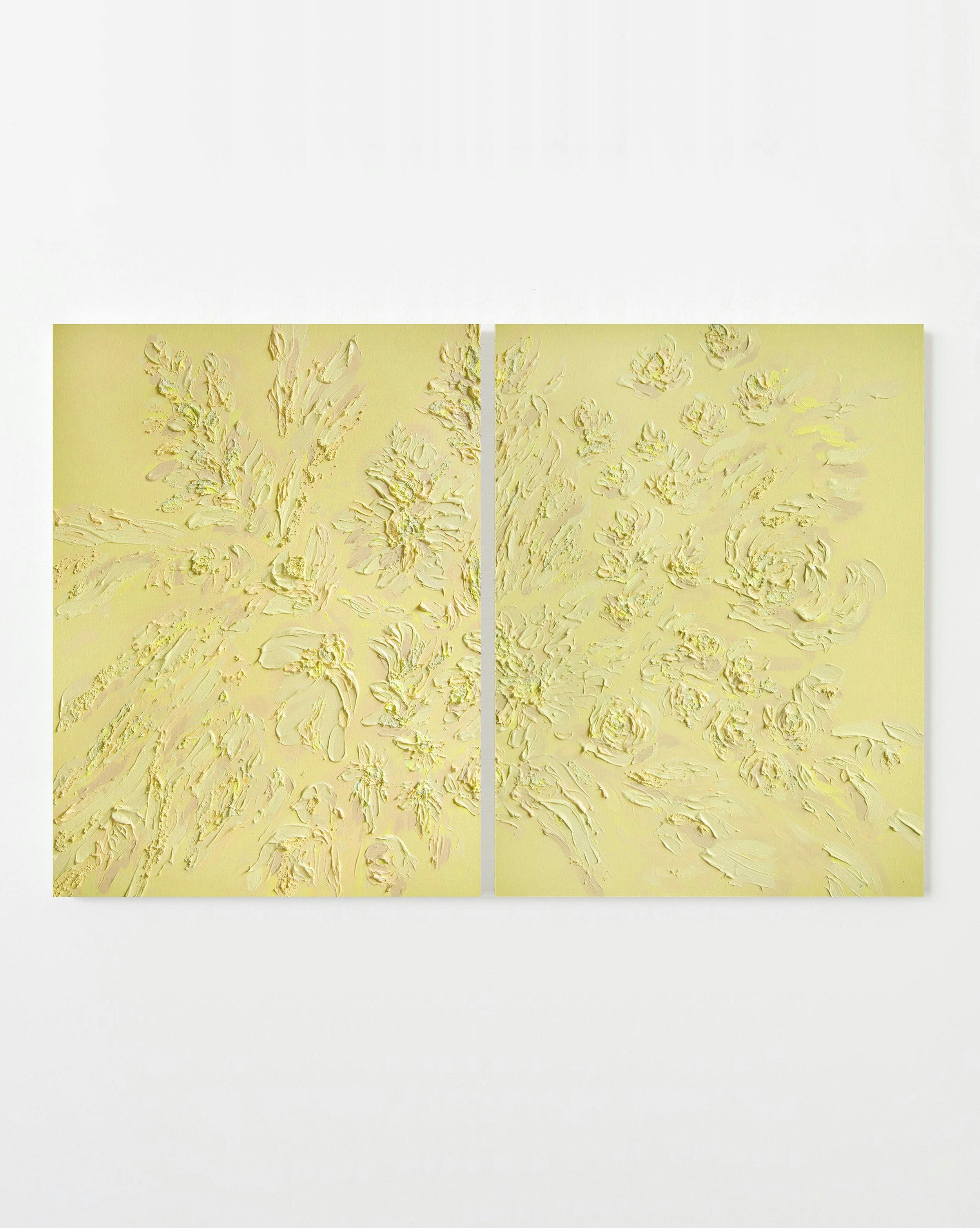
But right now, these current paintings are a response to memories of Los Angeles. From the time I was in my twenties up until more recently, and because of becoming a new mom, I think more about memory. I think more about capturing that memory. What does that mean? Especially with my daughter, and how fleeting some memories can be, and how time moves so fast. And especially after the fires happening in California, in particular in Los Angeles, last year. I've painted the fires before, but I didn't really want to paint the fires again. I wanted to paint images of memories of happy times in Los Angeles. Especially with all the trauma that is going on in the world right now, I think holding on to anything that gives, a glimpse of a memory of a happy place, is sort of like - I don't know if it's resistance, I don't know what it is - but it's something that I guess I needed for myself in order to start working on a larger scale project that isn't necessarily going to be about memory, but about the resistance of plant life and how that also correlates with the resistance in humans.

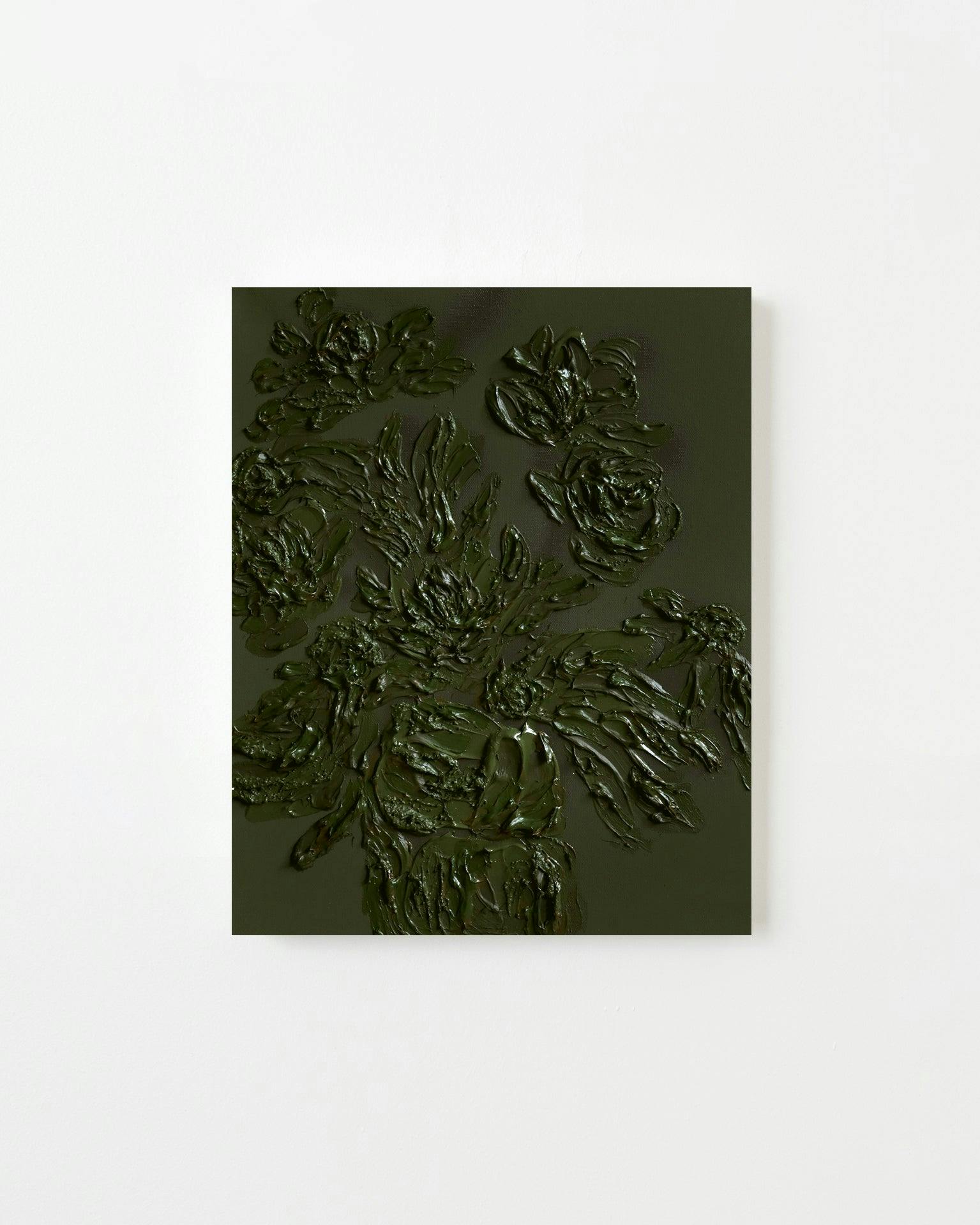
UA: Absolutely. I think what you were saying about memory and having something to hold on to is interesting in the way that you're using materials and color in your work. I think that these colors to me feel like a very specific sensory memory and recalls that golden light that you have in Los Angeles. And, you know, the way that you're handling paint, I feel gives a very tactile quality to those memories too. When you were developing this style and way of working, was that something that you were thinking about?
ELW: Yeah, light has always been a huge influence in my work. I think that stems from having studied photography in college. I use natural light in all of my photography work, and I do feel that translates back into my paintings.
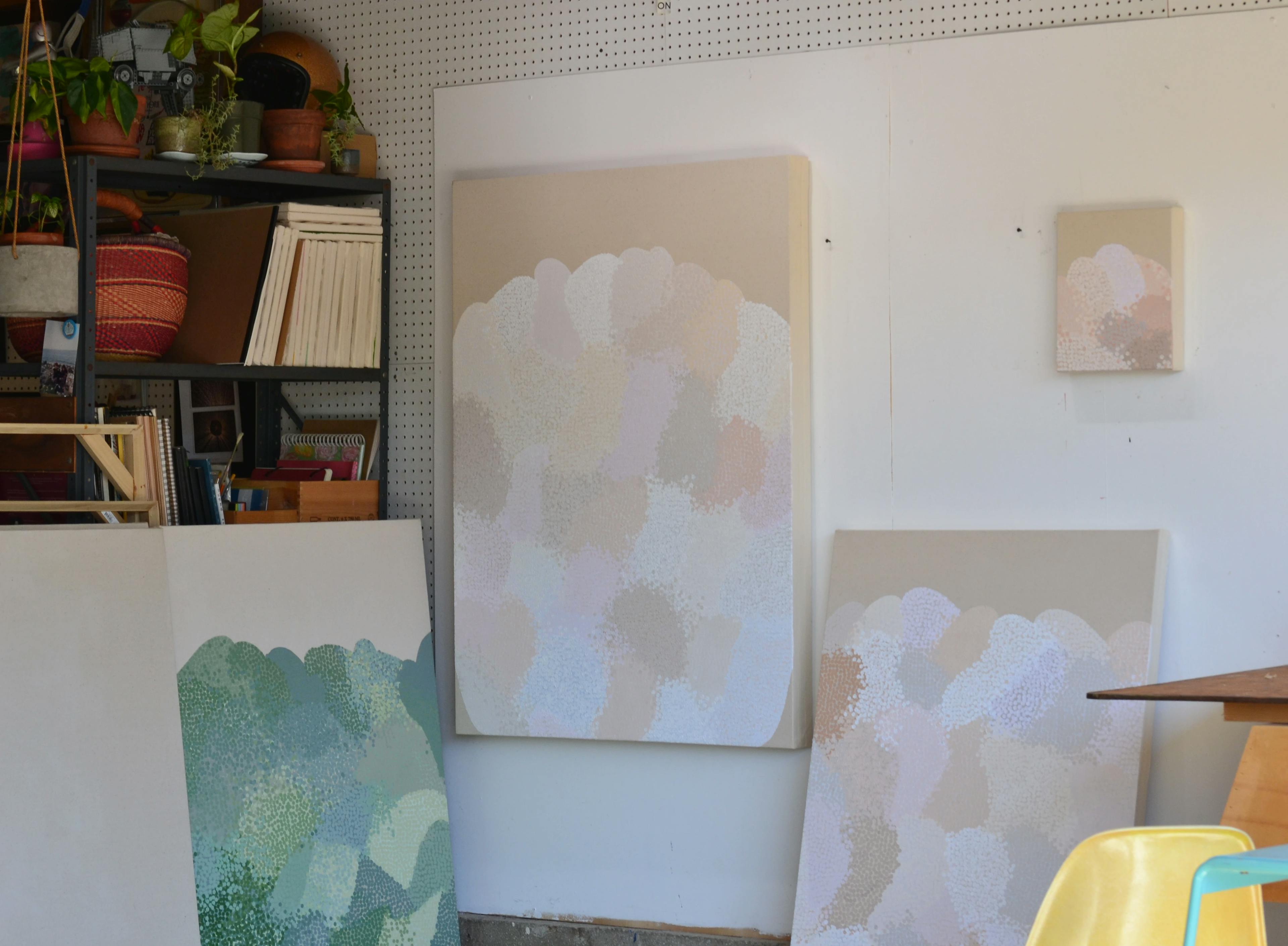
For this series, I did want to bring back more color. After I had my daughter, I really took out all color and just focused on monochromatic palettes, and I wanted to start bringing back color into my work, but in a more sophisticated way. I wasn't really loving the way I was approaching color before - I wanted it to be more subtle and to not be as bold.

UA: Can you talk a little bit about your transition from photography to painting, since you started out studying photography? And I know that you take a lot of photos that then feed into the paintings, but you're never really working one-to-one from the photo.
ELW: Yeah, I mean, now I've been collaging - I've really actually brought photo back into my work in a strong way where I'm piecemealing together my own compositions, instead of always just painting from an actual photo. So a lot of the bigger projects I've done, like for Hotel Lucile, I was able to take tons of memories of my friends' gardens, of places we've hiked, of different landscapes of Los Angeles, and combine them all together to make my own compositions.
And I've also translated this into commissions recently, like one I did of the Delaware River. And that part actually has been really exciting with my work. And that's something I'm going to continue in the next series. These new works have been just straight photos of memories, but the idea of being able to have more control over my compositions instead of just one single image and be able to translate it into different ways, has been a more exciting route in my work as of late.

UA: I feel like that adds to a lot more of these nuanced plant forms that get developed within the paintings themselves. That happens through the way that you're handling paint, but also the way that you're kind of re-mixing these different floral species together.
What questions or tensions feel most alive in your work right now?
ELW: I just really want to hone in on my craft. I feel that with being a working mom, you have little to no time in your studio. It's not the same as what it used to be before I had Zizi. And with clients, especially with commissions as of late, my timeline keeps getting shorter and shorter and shorter. So really, for me right now, after finishing this body of work for the show, I just want to have my studio completely clear and just really focus on the compositions of piecing everything together for my next series and just honing in on my craft and honing in on color.

Having traditionally been an oil painter, and having been working in acrylic to make it look like oil for the past six years, now - there's a tension really in the pigmentation of the paint itself and the way the color shifts happen - you cannot get it with acrylic at all. Just really having the time to perfect that for me is what's important. I know what the ideas are for myself, but really it's a time of my craft and trade. That is where the most tension is. My work tends to be very rapid fire because it's an energy thing, and all of my work is very intuitive. But sometimes I wish I had more breathing room to be. And this is something on myself - to step back and be able to assess different areas a little bit slower.
UA: I feel like that breathing room and time is something we’re all always trying to find! Are there any other materials or processes that feel especially important to you at this moment?


ELW: I would really like Golden to start making fiber paste again. I can't find it anywhere, and it's my favorite, and I need to write them a letter. I'm having a hard time with this, they stopped making gallons of medium - they're only doing quarts. So, I have to patchwork finding gallons in different places now, and it's been pretty stressful.
UA: That sucks because that's obviously a huge part of achieving the texture in your work. You should give them a call! They actually have very good and responsive customer service.

Are there any other artists or thinkers or cultural references that are shaping how you see your work at the moment, or what's driving some of what you're trying to get after through the paintings?
ELW: I mean, there's always been the heavy hitters in my work since I was in my teens, which are John Singer Sargent, Pierre Bonnard, Claude Monet, Cecily Brown, and Joan Mitchell.
But truthfully, it's seeing the work that my friends are doing - and I'm not just talking about artists, I'm talking about my friends who are writers out there, you know, writing amazing articles, doing amazing lectures with other authors. My friends who have really kept to their craft and really perfected it, and pushed it to different boundaries.
So truly, it's my friends. You know, I could go see every show that's out there, and I like to do that, and I like to see art, but really, it's the inspiration coming from seeing what my friends are doing. Non-artists or artists or writers or, you know, professors and their determination and their work and the way they’re pushing the boundaries for themselves gives me a lot of inspiration to push those same boundaries for me.

UA: And I know you have that friend who has a flower farm too, and their flowers and arrangements have been a source of inspiration.
ELW: Oh, yeah, Taylor, yeah, yeah - Fox Fodder Flowers! She's been my inspiration for all of my florals now. I mean, we have joked that we need to make a book at some point, and we probably should, because it's been about 15 years of me painting her arrangements.
UA: That would be awesome. During another studio visit that we had, you were talking about how you're reading a lot more about native and non-native plants, and how the history of colonization has shaped the landscape, too. Are there any particular books or writers that have been important?
ELW: I actually took a class. I took an online class after the fires. I would be signing on at 10 pm New York time for 7 pm California time, but I did take a class - two different classes, one about the colonization of plants in California and another about the native versus non-native plants. And I mean, it's really interesting, the native plants - the teacher was showing examples of how they're fire-resistant. Being in LA this past month, and seeing palm trees being planted at LAX where it’s under construction, it's like..well, those aren't native at all, and they're not fire resistant.

UA: And yet we associate the California landscape so heavily with those plants.
ELW: Yes, the streets lined with palm trees. But I don't always necessarily when I think of LA think of that - but that's just because my focus has been different with the landscape. I think of all the Cypress and Seuss-like trees in Elysian Park, which some are native and then some aren’t - or I think of the mustard that grows throughout Los Angeles, which is in season right now where there's these big, tall, yellow flowers and you'll see people posting about it on their hikes and everything. They was actually used to track indigenous cultures by the Spanish, to see what pathways they were going, because they would be able to follow them that way. But the mustard still grows everywhere, and it actually takes out all the nutrients from the native plants in the area.
UA: That's so fascinating. Well, scary! But so wild.
ELW: Yeah, it's pretty wild. These roots of colonization are still everywhere, but we don't always see it until we start looking deeper. You see it more in California than necessary. You see it out here on the East Coast with landscape work. But yeah, those are the the two things I can point out, especially the mustard plant. That's a big one.

UA: Are there any personal or historical narratives that surface in your practice?
ELW: Well, I've been trying to be more intentional about that. So with two murals I did, one being in the West Village most recently, I focused on the native plants from the High Line and Agnes Denes' Wheatfields for Manhattan, and combined the composition of both of those as a tribute to the High Line and the native plants, and to Agnes because of how that area sort of collided between the two. Because I wanted the mural to be of native plant life, and have some sort of historical context to the building and the location. So that was a way for me to give a tribute to her and a tribute to the work, and the beautiful work they did at the High Line with the native plants.

A project I did in LA about a year and a half ago, Hotel Lucile, that I mentioned earlier, which is the biggest project I've ever done - I developed two murals, one where it was at the arch of the church (because it's a church being converted into a hotel) where you’re looking out onto Mount Baldy, and you have this landscape you see in all of the mountains, but you're up somewhere where it's really lush, because when I stay in LA, I'm always on the east side and the hotel is located on the east side, so the landscape on the east side is very different than the west side. So I wanted it to have that hilly feel. I put in aspects of native sage from Eaton Canyon. Some other plants that are native to Eaton Canyon as well.
The overlook is actually my friend Anna's, porch - Anna Beeke, who Uprise Art represents - and then down below, mirroring that mural. I wanted it to feel like you were walking through the lush sidewalks of Silver Lake or of Elysian Park. And so that was a combination of different friends' gardens. My friend Eduardo, my friend photographer Danielle Levitt, the native plant garden at Elysian. So a whole combo of patchwork in it together. Which is what's going to lead me into my bigger body of work. So, I want to be more intentional. I don't want it to be unintentional. And one of the most important aspects I put in the mural that's in the arch was that at Hotel Lucile, in the research I’d done, the church that was a Presbyterian church also used to be a safe haven for Chinese Americans when they came over to the States, and they used that stage as a theater. And so I purposely put in the cypress trees that have a similar gesture to Chinese art from the 1600’s as a reference to them, and the history of the church, and that stage being important for them in the 70’s.

UA: What kind of conversations do you hope the work enters into?
ELW: It's a hard question. I don't know where that fits. Does every artist know where that conversation about their art lies? I mean, what's been interesting is, for instance, my Botany Mono work, I created that during Covid as a response to the grief and loss, and how flowers can represent so many different aspects of our life, from love and positivity to sadness and funerals, and everything in between.
I was thinking about how everyone places flowers on their altars. And then people started placing my paintings like an altar in their home. So even though that was what I was thinking about, I didn't actually really talk about it as much. But then people felt it, and it was placed.
Sometimes I like to leave my work open-ended for people with that. It's, you know, that conversation, I have more curiosity about what people interpret my work as than necessarily having to tell people what it's about. And I think that's okay. I think, as an artist, you always have to constantly be curious, and I like to keep my focus within the curiosity of things, even for myself, because a lot of times my work is so intuitive that I do it before the words come. And I think that's something that's not really talked about a lot within art.

UA: I think that an important part about art is that exchange between the artist and the viewer. You know, I think that the artist can have all the intentions behind what the work means, what it's supposed to do, but then they can never control how the viewer is going to respond to that and what they're going to bring to that. I think that the marriage of those two things is really what art is - or what it should be.
ELW: And that's where I like to leave it right now, open-ended. You know, talk to me in a year, and I'm deep into a new body of work, I will have a different interpretation of that - but I think that's okay. I don't think there's a right or wrong answer to that.
UA: Definitely not - and it's not a trick question.
ELW: Oh, I know, I'm just saying. But, you know, I think that some people, some artists, their work is specifically about conversation. And I mean, I think art should always be a conversation. I guess for me personally, it's always been so intuitive coming from my gut, and that's something that's not always talked about with art. My friend Camille actually did a whole article about intuition and art, and I told her that was a really important thing to bring up, because it's not talked about. So for me, with my art being so intuitive, that conversation with the viewer - I'm more curious about what their intuition feels from it than necessarily anything about myself.
I do hope that the work encourages people to reconsider the environments around them. Landscapes aren't just about scenery. They're living systems that shape our emotional response and culture. And I think that's something I'm constantly trying to strive for within my work. And a lot of the landscapes I painted in my twenties were about love and heartbreak. But now it's not about that at all. It's really about the human connection during a time that it's - it's just the tensions are there. We're seeing communities being bombed or families broken up - what is a way to keep connecting with each other?
UA: And I think what is a way to keep connecting with nature, too? We act like nature is a finite resource but -
ELW: She's taken for granted. If the paintings invite people to pause and notice those relationships more deeply, then the work is doing its job.