Guide to Fine Art Prints

A fine art print is an original artwork produced through a hands-on transfer process. From carved woodblocks to limestone slabs, the tools and techniques vary widely, but each method gives the finished work a distinct character. In this guide, we cover the four main types of prints, how editions work, and a few key terms to know. For quick reference, a full glossary of common terms is included at the bottom.

Print Types
Prints can be any form of art that involves a transfer process using a plate. Plates can take many forms, from a piece of wood where carved areas act like a stamp, to a sheet of metal where recessed areas suspend ink. Plates are not always a durable material. In collagraphy, the plate could be found materials, like cardboard, thread, bubble wrap, or leaves, which are inked to create direct indexes of the material. In screen printing, the plate is replaced with a mesh screen. A broader term, matrix, can be used to describe the plate, screen, or other tool that is repeatedly used to print.
Broadly, there are four types of printmaking: relief prints, intaglio prints, lithography prints, and screen prints. While there are many subtypes within these categories (along with countless combinations of multiple techniques), these four types of prints are unique in their inherent methods.


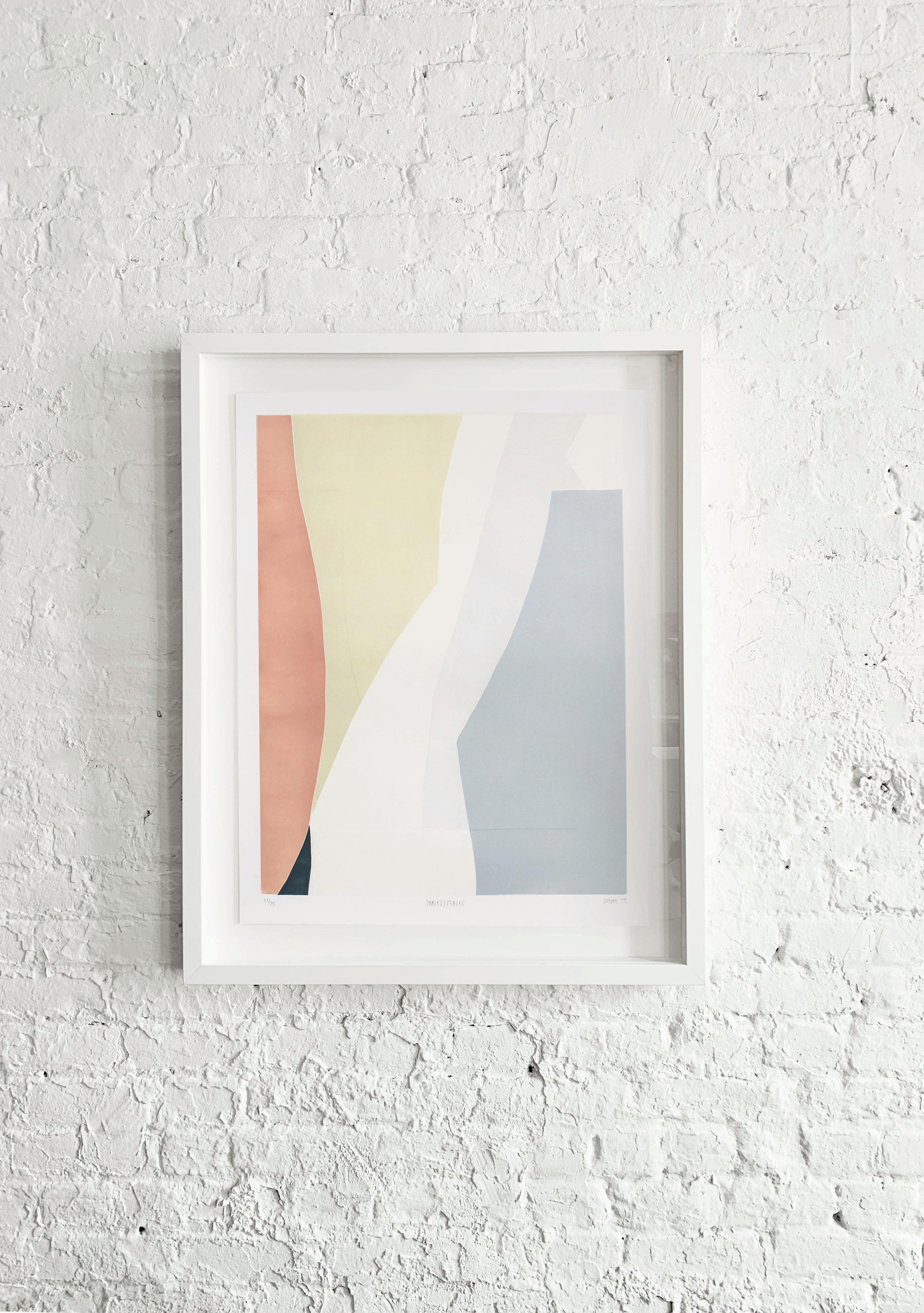
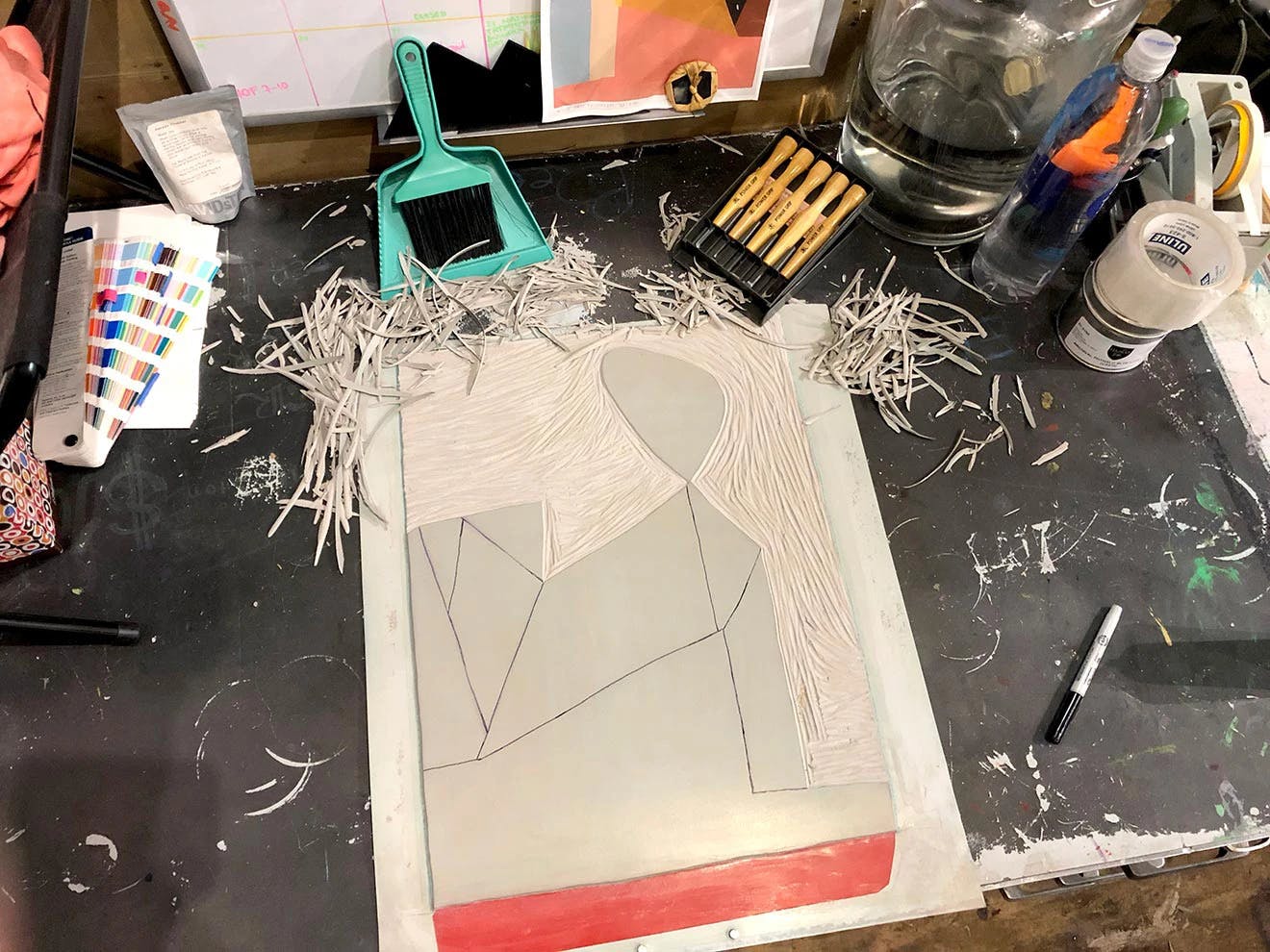
Relief prints operate much like a stamp. The artist carves into a soft material, typically wood or linoleum, and the raised, un-carved surface holds the ink. When pressed onto paper, those raised areas create the image. Relief prints can be made by hand or run through a press, and include woodcuts, linocuts, letterpress, collagraphy, and blind embossing. To create a relief print with multiple colors, such as Scott Sueme's print Traces/Places, the print is run through a press multiple times, once for each color.


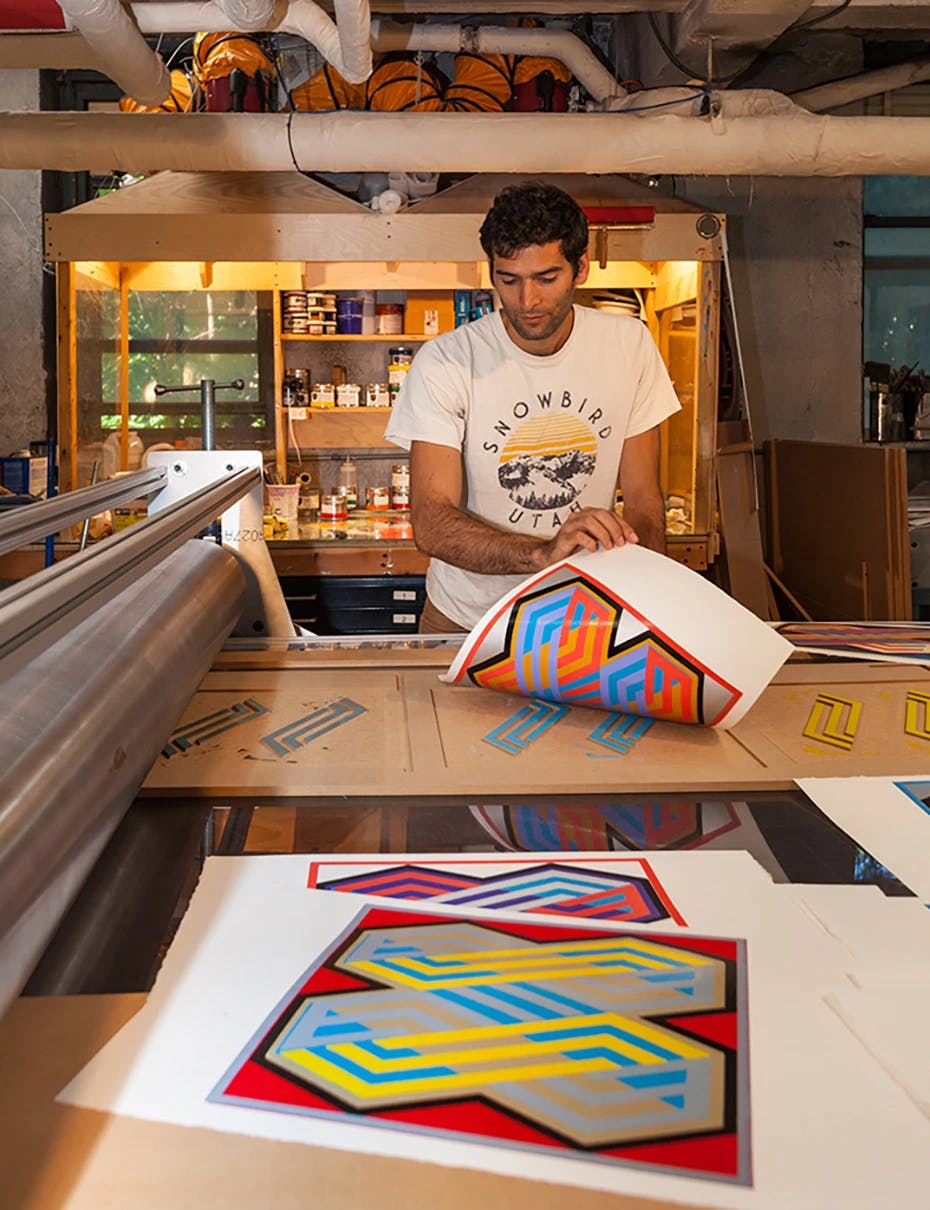
Intaglio prints (pronounced in-tal-yoh) are the inverse of relief prints. Instead of printing from a raised surface, the image comes from carved or recessed lines in a metal plate, typically zinc or copper. The artist incises the image using sharp tools or acid, then inks the entire plate and wipes the surface clean so that ink remains only in the recessed areas. The plate is run through a press with damp paper, which pulls the ink from those grooves. The technique allows for a wide range of effects, from fine, precise lines to soft tonal gradations, and includes engraving, drypoint, mezzotint, etching, aquatint, spitbite aquatint, and photogravure.
Lithography prints work on a simple principle: oil and water don't mix. In traditional stone lithography, the artist draws directly onto a porous limestone slab using oil-based materials like litho crayon or tusche, a carbon pigment. The surface is then treated so that when ink and water are applied, the ink adheres only to the drawn areas and is repelled everywhere else. Because the artist draws the image by hand rather than carving it, lithographs can have a fluid, painterly quality, like this work by Ruben Castillo, that sets them apart from other print types.
Screen prints (also known as silkscreens and serigraphs) are a stencil-based method of printmaking. A mesh screen is prepared so that ink can pass through certain areas and is blocked in others, creating the image. The process starts by coating the screen with a light-sensitive emulsion, then placing a negative image over it. When exposed to light, the emulsion hardens everywhere except where the image blocks it. Those softer areas are washed away, leaving open sections of mesh where ink is pushed through with a squeegee. The resulting image tends to be crisp and graphic, which you can see in works here and here.


Editioning
If a print run is a limited edition, the artist prints a set number of impressions and then retires or destroys the original plate, screen, or stone.
Each print in the edition is nearly identical, with the possibility of small variations, and is numbered in the order it was printed. A limited edition of 10, for example, would be marked "5 of 10" to indicate the fifth print out of ten total. An open edition, by contrast, has no cap on the number of impressions and would simply be numbered "5" with no total. For collectors, edition size is one factor that shapes a print's value and rarity.
For some editions, the artist or printer may choose to include an Artist Proof (AP) or Printers Proof (PP). PPs are rarely available to collectors since they’re kept as records by the printers, but APs are often available as an early version of the work. An AP might have a different color scheme or another element that makes it different from the rest of the edition.
Monotypes and monoprints are one-off prints where no two impressions are identical. Monoprints are created from a plate that has been manipulated in the printing process with an experimental application of ink or another unique intervention by the artist. A monotype image is a work painted directly onto a smooth unaltered plate and then transferred to paper in a press.

Quick Guide
Aquatint and Spitbite Aquatint: An acid-based intaglio technique that works alongside etching to produce tonal variations to complement line work.
Blind-embossing or debossing: A relief printmaking process that creates a raised or recessed image on the paper surface.
Engraving: A type of intaglio printing where a metal plate is incised with a tool called a burin that is manipulated at different angles with different degrees of pressure to create a varying line weight.
Etching: After a plate has been coated with an acid-resistant ground, the image is scratched away with a sharp tool. This process of intaglio printing uses acid to deepen the image that has been cut into the plate by exposing the plate underneath the ground.
Drypoint: A type of intaglio printing similar to engraving, drypoint is a process in which marks are made on a plate using a sharp, pointed instrument. In drypoint, the curled burr of the displaced metal gives the final print a soft velvet-like quality.
Intaglio: A category of prints made from cutting into the printing plate with tools or acid. The recessed portions of the plate hold the printing ink.
Limited Edition Prints: Prints made with a limited number of reproductions.
Lithograph: A type of print made by drawing an image with a greasy material onto a flat stone or metal plate, then using the natural repulsion between oil and water to transfer the image onto paper.
Mezzotint: A type of intaglio printing where the entire metal plate is roughened by marking fine lines into the plate in all directions with a tool called a rocker. Tonal values are built up by burnishing or scraping into the plate, working from the darkest portion of the image into the highlights, allowing the print to have continuous tonal range.
Monoprint: A one of a kind print that utilizes a premade plate.
Monotype: A one of a kind print.
Open Edition: A print run with unlimited impressions.
Photogravure: An intaglio process for replicating photographic images.
Photolitho: A lithographic process for replicating photographic images.
Plate/Matrix: A template used to create a printed impression.
Pochoir: A stencil-based printmaking method where color is hand applied with a blunt brush.
Press: A press is a piece of machinery used to apply pressure to the printmaking plate in order to create a printed impression on the paper.
Printers Proof/ Artist Proof: An impression printed separately from the numbered edition.
Reductive Print: A technique in relief printing where each print layer is carved from the same block.
Relief Print: A category of prints made from a raised surface of a printing plate. The raised portions of the plate hold the printing ink.
Screen print/ Silkscreen/ Seriograph: A stencil-based printmaking process where ink is squeegeed through a screen.
Woodcut: A method in which a block of wood is carved and the image stands out in relief.