In Conversation with Senem Oezdogan

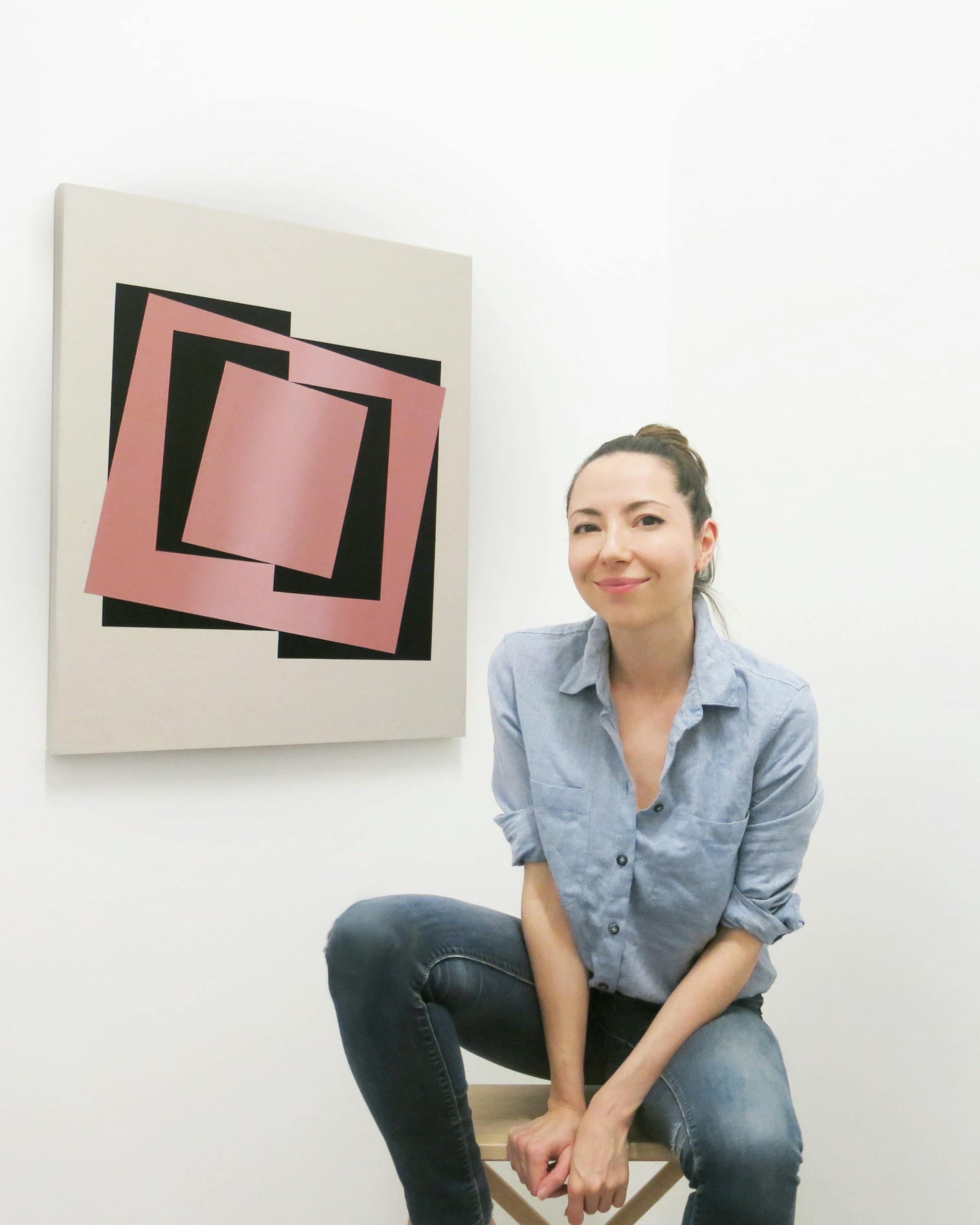
We chat with Senem Oezdogan in her Brooklyn studio about the specificity of material, and knowing the right moment to share new work. Read the full transcription of our conversation below and watch the video here.
Uprise Art: Who are you?
Senem Oezdogan: I am Senem Oezdogan. I am a painter, originally from Germany, but now I live in Brooklyn.
UA: When did you start developing this work?
SO: I started developing the gradient works around 2014. The earliest incarnation of these works was a series about Martha Graham's choreographies. I made a series about her whole philosophy of contraction and release. I felt at the time that the gradient works really, really helped visualize that concept, and from there it evolved - and changed and came back, then changed again - it's an ever-evolving concept.
UA: Can you talk a little bit more about how you create the gradients?


SO: I use acrylic paint because it's a material that has a lot of limitations when it comes to gradient painting, but the limitations also create the look of the work. It's kind of an artificial surface. It has a very smooth transition into the gradients, and with oil paints, you don't really get that. It limits me from trying to be too perfect. It forces me to stop at a certain point. With oil paint, I could just go on forever and refine the work endlessly. With acrylic, there is a certain drying time. There is a certain amount of paint I can use on the canvas, so those limitations are what, in the end, really shape the work. I'm not saying I would never use oil to make gradients, but for this body of work, acrylic is my favorite material right now.
UA: And you're always applying it by brush, by hand. It's never airbrushed.
SO: It's never airbrushed. I use a lot of brushes and quite a bit of paint, and it's very repetitive. It's a very physical process. It's also my favorite part. But over time, the work also changed. Back in the day, it was more about creating the perfect surface and removing the painter's hand. But now, with this new body of work, I really want the brushstrokes to be visible. It adds a whole new element to the work. And again, acrylic does it in a very specific way that really adds to what the work looks like in the end.

UA: Yeah, definitely. I feel like acrylic is always going to have this plasticity to it. But since you're working in these really thin layers to achieve the gradients, it ends up having sort of like a velveteen quality. And I really like in these new pieces that thats is accentuated by the brushstrokes that are still visible. You can imagine, like velvet, rubbing your hand across it and shifting the direction of the fibers.
SO: Exactly. Also, for this body of work, I really wanted the brushstrokes to be visible because the work is about movement. It's about how these structures move across the canvas. Some of them feel like tectonic plates, almost, or streams, and the direction of the brushstrokes really helps in visualizing that movement. So, if the work in the past was really about having these sculptural forms frozen in time, now it's the same concept, but these forms lose their stability, and they really start coming apart and moving across the canvas.
UA: Do you see these forms as specific things? I know you just mentioned a couple of influences from nature. Are you thinking about that specifically when you're making these pieces?
SO: Well, there isn't really narrative in the work, and I wouldn't say I'm painting specific things, but I will say that I see myself as a collector of fragments, so I will navigate through the day or through things, and I will always pick up, some sort of a shape or a curve or something that really speaks to me. It could be really banal, you know, but when combined with something else that spoke to me before - it always adds up to these really exciting things that seem impossible, but once you combine them into these forms and structures, they become real.
That's the beauty of abstraction, when you get the painting to the point where it seems like it could be something you recognize, something real, then it can move again and fall apart, and it dissolves into, you know, nothingness or something - something that something else could emerge from.
Senem Oezdogan

UA: How do you see your newer work in relation to these gradient pieces? The newer work being these sculptural pieces that have a kind of biomorphic quality to them. They seem like they want to be flowers or some sort of organic object, and I think due to the fact that they are three-dimensional objects, they don't quite have that same slippage as you get with the paintings, when you're playing with space.
SO: I think at the end of the day, what I really always want these works to be is some sort of a vessel for an experience - and everyone who encounters them comes with a whole different set of references in front of these pieces. So I love that it can be something different for everyone else, how they connect the dots for themselves, and I always envision it in the most abstract sense - if five people read the same book and dove into this adventure, everyone would see something completely different in their mind. It'll be a completely different experience for them, and I think that's a little bit what painting is for me. We all see the same things, but it's very personal how we encounter them, and sometimes it can be very meaningful that you have a sensation, or sometimes you just indulge in a beautiful color, and you can sit with it, and you just, for a moment, really enjoy looking at the color pink or getting lost in a blue.
I think gradients are really excellent for that because you have these transitions in color.
I always enjoy when I finish a painting, how I can sit with it for a little bit, and I see how one color transitions from one to the next, and you have this moment when your brain tries to see the exact moment when that transition happens, and that is really when it becomes contemplative because for a moment, you just space out. I think that's very successful for me.
Senem Oezdogan
UA: How did the sculptures come about? Can you tell me more about that process?

SO: The sculptures do connect back to the paintings. I have been working on the sculptures for maybe a little over a year. I've always experimented with textiles, I've done pieces with rope in the past, and other weavings. I’ve always liked textiles transformed into some sort of sculptural element. But this time, I really wanted something more intimate I could touch and form and see the tension and consequences in real time. The work is very intuitive; they’re made of nylon which is a material that is very elastic, and you have to respond to the material's resistance.
And in the same way, it happens in painting, too; you engage with the material, and you have material resistance. For me, that's the most fun part. You engage with it, and you want to create something, and the material doesn't always give in, so you have to learn a little bit about it. Every color is different. Some colors are transparent, and some are really opaque. Once you learn that, you can really use them as tools. It's the same with the sculptures. You have elements like nylon that stretches, and you have wood that breaks, and you have wire that really doesn't always bend the way you want it to. So there's always this element of unpredictability that's exciting - it's fun, and it's frustrating, but in the end, it's, when you really stay with it, you can create these really unexpected things, and I think that's what I wanted to create with the sculptures. I can form them, I can touch them, I can see the tension - they can unravel, then I have to deal with it in real time, and I have to figure it out because I can't go back. So every time something unravels, it becomes a new thing.


I have this tension in the sculptures, and I can see the form emerge, and I have that in painting, too. It becomes a three-dimensional object, but at the end of the day, it's an illusion, right? So, I carve out those convex and concave shapes in the canvas, but again, it's a flat surface. But to do it with an object in the real world and then come back to a canvas and still have that mindset of forming something, I think that really contributed to the way this body of work looks, because it looks like it has a temperament now. You see the brushstrokes, and it's animated, and things are moving.
I think having worked on the sculptures and then coming back to the paintings has, for me, affected painting in a very positive and unexpected way.
Senem Oezdogan
UA: Can you describe what's currently driving your practice, both with the paintings and sculptures?
SO: I think it’s kind of what we were just talking about, having the luxury of having both of these experiences, where you can create form, and have something three-dimensional in the real world, but then also you can take these thoughts and flatten them and apply them to the canvas. What interests me in the paintings and sculptures is how do you visualize tension, how do you create a structure that is just about to lose stability? In the paintings, the stability comes from the grids and from the gradients. So it looks like something is dripping to the foreground, but it's actually not. I am painting the grid, and that optical illusion will direct what you will see. It's really interesting to bring that to the foreground or the background in all these paintings. In the sculptures, you're dealing in real time with the consequences of what the material is. You can bend and form things, and they’ll unravel and shift. I think that sensibility is coming through in the looseness of the brushstrokes in the new paintings. There is a lot more movement.


UA: Would you say that that’s one of the tensions that feels most alive in your work right now?
SO: Definitely. The material resistance is extremely important.
If you work with a material for a very, very long time and you master it and you get to the point where the material is not fighting you, it's not making you ask new questions, right? You want to evolve, but if you get too good at something, then there is a risk that the work can become some sort of formula that you repeat, and it's always that. So for me, it was really important to look at materials and see, what can this material do?
Senem Oezdogan
With the sculptures, there is a really beautiful duality to nylon. It could be very solid, and it could be a parachute, or it could be very delicate, and it could be stockings that rip. So, you have this industrial side, and you have this very delicate side. So how do you bring these materials together, and what can you do with them? What can it be apart from what it is or what it exists as? I think that's always been the thing that drove me to make art and choose my materials because I want to always push a little further - like, this is what it is, but what else can it be? Acrylic paint has all these limitations, and it's expected to look or perform a certain way - but what can I do? How can I engage with this material and transform it in unexpected ways? And that's really exciting to me, and I think that is something that really keeps the practice alive. When you love the material, and you can really rediscover it over and over again, it's like, how many times can you turn a stone, you know, so you have this thing, and you engage with it, and unexpected things happen. I think that is really what's fun in the studio. You become a scientist because you can experiment with these things.

And then again, you know, you can take this nylon material, and you can turn it into a really solid sculpture. If you rip it, it rips, but you can find these ways to really transform it, and make it into something really durable, and these tiny little acts accumulate to something really solid.
In the paintings, it's these tiny little movements and these tiny layers that accumulate to these really solid surfaces and structures that, at times, can almost feel overwhelming, but then you take a whole different set of colors or change how you paint it or approach it, and it becomes light.
Senem Oezdogan
UA: Are there any personal or historical narratives that tend to surface in your practice?
SO: I wouldn’t say there's a narrative in the work, but it's kind of what I mentioned before that I am a collector of fragments, and everything I encounter, I am certain finds its way into the work in some way. I take a lot of photos of my everyday life, especially on the way to the studio. I will see something discarded and take a picture, and the next day it may have moved a little bit, and it's still the same thing, but it changed because the wind blew it in that direction, and I’ll take another picture. So, you have all these different things that are kind of always the same, but when you take them apart and rearrange them, it creates a whole new reality, like a collage. I do a lot of collages. The base of everything that I do is collage work, and so, these fragments accumulate too. There is a basic idea and a grid, a structure I will work within, but colors and ideas will always find their way into it.


UA: What kind of conversations do you hope the work enters into?
SO: I do believe that the work is always a vessel for experience. I hope that people can look at it and find certain things or see certain things that connect to their life - or they can just enjoy it or indulge in a color or shape or form.
UA: Are there any artists, thinkers, or cultural references that you're thinking about when you're making these pieces?
SO: For a lot of these works, I have been very inspired by Gilles Deleuze’s Fold Theory that I really, really love. For him, the world consists of folds, and it's an ever-changing system. It's always the same, but it always bends and shapes in different ways. That’s how I see my practice.
My vocabulary and my systems are, at their core, always the same, but as I change as a person and as an artist, and the things that influence me over time shift, the work gets molded into different situations and inspired by different things. So the core idea is there, but it always transforms.
Senem Oezdogan

UA: What directions are you excited to explore next?
SO: I am really excited about digging deeper into the sculptural work and hope that I can continue to learn as I go. When you start a new body of work, there is this moment when you can't really say if something is good or something is bad, and you're free of judgment, and it's such a pure moment in a practice where you create without having to be really harsh with what you make - you're giving yourself space to just make things. It's a very frustrating moment because you don't know what you're doing and, it takes a lot of time for things to emerge, but it's also such a fleeting moment. It goes way too fast, because once you're in there, it's kind of where all the good ideas come from, and it's that first moment where you see so many things and you try to make sense of what it is that you want to create. I think to be able to stay in this moment a little longer, I always try to treasure that because it's gone so quickly - you have a set of these core ideas, and then you have to make it into something good or something bad. Then, you know, the judgmental side of the artist will come in and shape these things. So yeah, that's always a good spot to be in.


UA: Do you feel like you prefer to have an incubation period in the studio before you share work with anyone?
SO: Yes! I am not big on crits, unfortunately, but it's because I think I'm a very critical person, and things really affect me in that sense. I appreciate feedback, and I love it, and I think it's very, very beneficial, but as I said, that moment of pure creation when you're just starting to do something, and you have a body of work that’s just beginning..it takes a really long time. When you haven't really formulated your own ideas yet, and you have other input - it can be confusing and derailing. Eventually, I would say I would probably find my way back, but for me personally, I love being in my own space for a little bit, not sharing, and really wait and see where the work takes me. I also have a lot of work that I started a long time ago, and I just wasn't ready to share, so I put it aside. Sometimes you have to become that artist first - that artist who can make that work. You have to improve, or change, or see things differently to pick up a certain body of work that at the time was a spark of something, but it didn't really make sense. So yeah, I have a lot of these starts, and I like to let them sit for a while. Even with the nylon sculptures, they were always in the back of my head, but it took me a really long time to connect the dots and explain to myself what I really wanted to make with this material and how I wanted it to look.

UA: That's such an important part of being an artist, too. To envision the longevity of your career, and to understand that you will have many ideas over the course of your life as an artist, and sometimes you'll know exactly the right tools and methods to create, and other times you'll have the idea, but you won't really know how to approach it. But that idea can live as a seed, and as the years go on and you have new experiences and you grow as an artist, you come back to it, and you're like, oh, now I know exactly how to approach that.
SO: Exactly. That's how I see it, and it's helped me a lot. I’ve had moments in the studio where I regretted that I shared things too soon sometimes. People ask what you’re up to, and obviously, you know, it's important that people ask the questions about your work, but you don't really have the answers yet because you haven't taken it to those points yet. So yeah, for me to sit with ideas is really, really important. I don't want to share too soon, but sometimes you have to, and you have to be brave enough to make something and then put it out in the world and be like, it is okay - I can start here, and I can refine, and I will figure out the rest as I develop it.

Published April 2026