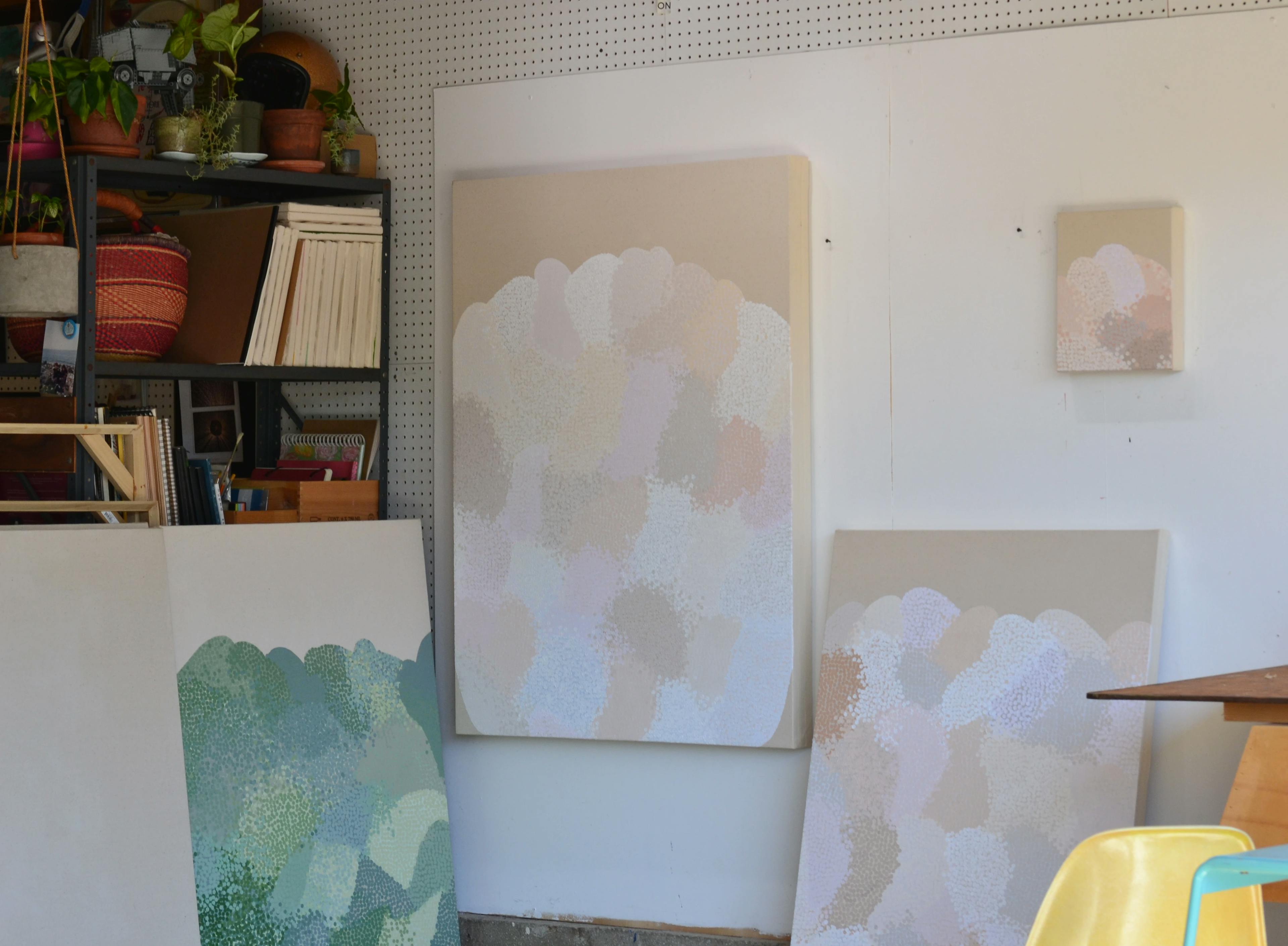
Bryce Anderson's Unexpected Inspiration

In our conversation with Bryce Anderson, he reflects on family, archives, the unexpected origins of his latest paintings, and the importance of leaving meaning open-ended. Read our entire conversation below and browse his newest works here.
Uprise Art: What have you been working on in the studio?
Bryce Anderson: I’ve been making work in response to fabric offcuts sent via post from my mother up in Queensland. Utilizing found imagery again has been a nice break from more researched and labored-over subject matter. These offcuts are from the remnants of my mother's quilts, which she has been making with thrift store fabric scraps since before I was born. Some exist as wall works with batons to hang from; others act as functional quilts in the colder months. Ironically, it's taken me a long time to realise the significance they had on my practice.
Like a lot of my work over the last couple of years, the origins of the source material come from personal narratives but arrive at a more universal resolution. My motives for making the work don't need to be translated so directly into the completed painting; they exist as something personal yet universal - or at least familiar.


What I wanted to include in this group of paintings and continue with for my show at Uprise Art in 2027 is two streams of working - two coexisting bodies of work. Stylistically quite different, they are still at their core collage. I’m interested in getting two images or things to coexist that generally shouldn't. The figurative work included in this series was made last year. It’s a painting of my partner, Cecilia, including the Mary Janes depicted in the work shown at Uprise Art in 2023, and suggests what direction the more figurative paintings will take.


UA: Tell me more about your decision to use textiles as inspiration in the work.
BA: In the same way that I've used found books previously, I really like the parameter setting of just deciding to pull imagery from this one book and then seeing how that could work. That's how I've worked in the past, where I set limitations for myself because when you're working with found material, it's endless.

I’ve really enjoyed collaborating with my mom for this because she has no idea what I'm looking for - and I don't really know what I'm looking for. The only limitation is scale since she’s sending her scraps, and they’re traveling through the post - but it’s heaps of variations.
Since they're all from my mom, they're all personal in that they’ve had this whole life already. Maybe she's utilized them in some way or not, and then they travel through the post and come to me. There's something about that strange transfer of information and just reframing them. I think this one in particular lends itself even more so to a quilting aspect, as opposed to other pieces that have more of an imposing geometry.

What I've used in the past as far as found material goes is personal because I'm engaging with it. And the more that I engage with it, or the more that I recycle it with each iteration, circling back to an image, or cropping an image in a different position, is my relationship to that image. That continued engagement is what creates meaning.
It morphs into something that is mine, and then maybe the source material is then translated into a painting - but then that painting is translated into another painting. So then the reference becomes the painting prior. Just through that repetition is ownership; it’s a time stamp of where I was in my life and in my studio. It could mean nothing, but through your continued engagement, it becomes something; it signifies a point in your life, a specific time.
Especially so with these, I’m interested in whatever reason my mother was initially drawn to them because that’s already adding to the process of them being more personally bound.
Quilting, especially within her work, is very collage-heavy, and it's a very big contrast of printed imagery and textiles jutting up against other things. It's kind of whatever she can get her hands on, so I can really relate to that. Quilts in general always have a certain geometry to them. They have a structure or a repetition, which I think is something that always runs through my work as well. It took me a long time to realize that.

UA: How did this exchange start with your mom?
BA: In the last couple of years, we've really built a stronger relationship since my dad passed away.
Making this work has been an effort to become closer with the family that I have here, and I think it also coincided with these realizations of what her impact has been on my practice. It started with her sending photos of quilts she's working on, and I would send photos of paintings that I'm working on, and it encouraged a bit of dialogue. They're both very different worlds, but it's just nice to be able to share that.
Then I asked her to just send me some offcuts. I didn't really know what I was going to do with them. It was just a little hunch. I wasn’t thinking of what it meant. I didn't know what I was going to get, if it would work, so I just encouraged her to compile something, some things that she was willing to let go of - which is generally why they're just these tiny little offcuts, because they're not things that she can really utilize. So she compiled some and then sent them in the post. She sends about a hundred off-cuts per post pack. Maybe I like five; it kind of depends.

I gave her no parameters because I didn't really have any myself, and I think that worked out. I'll be curious now that she's seen the work that I'm making in response to what she sends, if that'll dictate what she gives me. But I hope that it doesn't, or maybe something will be interesting in her interpretation of what it is that I'm actually looking for.
UA: I'm really interested in how you're creating your own composite quilts from the magnified scraps that you're receiving from her. I was curious to hear more about the geometries that you're also imposing on top of the pieces. This piece with the floral pattern - it has almost this big black X over top of it, which makes it feel like something's being redacted or intentionally omitted or covered up.

BA: I really like the idea of the redaction. This isn't something that I had preempted, but thinking about it now with your reading, this isn’t the first time that I've made a work where there's a large portion of space that is just a block of color or white or black or whatever. But in the past, it had always been relative to the image that's included in it. So historically, there'll be maybe a more architectural kind of image, an interior or a still life or something like that, and those kinds of margins start to lend themselves to peering around walls or through windows.

And I think when you're talking about the redaction idea of it, I think it's because the patterns lend themselves more so to text as opposed to a window in a viewpoint that has some sort of depth to it. I'm working on them in a mechanical way, almost from left to right, so when you mentioned the redaction or obstruction, I think it existed in previous work, but it's relative to the source material. That work with the cross that runs over it, which is covering a portion of the pattern, is basically in relationship to a divide between my relationship with my mother around religion. She’s a born-again Christian, and I'm not a religious person. I can see the importance of it for her now, but when I was a teenager, it felt quite heavy-handed. So, I guess I was wanting to not, in a super overt way, acknowledge that.
And the cross is, I mean, they're everywhere within art, especially within hard-edge abstraction. There's an Australian-German artist who was working from the 70's onwards named Gunter Christmann, and he made these cross-based works.
Appropriation has always been a constant in my practice. Whether it be found material from a book or directly from a particular artist. Again, I could have overlaid any type of cross, but drawing from his work felt significant.
UA: I also wanted to ask you about the figurative works that you are developing in tandem with these more abstract pieces. Curious how you see them bouncing off of each other, relating to each other, contrasting against each other. How do you see these two bodies of work functioning together?

BA: With the last body of work that I created for Uprise Art, it was more of a call and response between the representational work and abstraction, where each piece consists of a similar composition or palette as the other.

In the same way that we're talking about the redaction of the cross, the figure turning away is also a form of obstruction. There is a cropping and a lack of information in the same way that these fabric patterns are being used, where they're these really tight crops where the information is pushed to one margin, or compositionally they're slightly off-kilter or something. So for that particular work, I think it works in the same way where I'm not giving you the information that maybe you expect, or making the composition how it “should” be.
But figuratively in general, I think I'm just getting to a point now where I'm just prying those apart, and it's essentially still collage, but they exist within their own canvas, their own space, as opposed to making them try to coexist within the one picture plane.
At one point, I was making a lot of work years ago that was really heavily collaged, and it was really flat and figurative, and all these things were trying to coexist.
Then over time, it's really pared down to what I would say was its most basic form, the last body of work that I showed in Keepsake. With that work, I wanted to see what I could get away - how much information could I pull out and still be compelling. I think that this new work is one step further in prying the image apart.

Over the last year or so, I've made a lot of different work when I didn't have anything that I was particularly working towards. I was jumping around a lot. I think it works for me to keep my attention span to just have two bodies of work on the go that are two different paces or two different languages, and then putting them within the same space and seeing how they can coexist.
UA: Yeah, I think another thing that I was thinking of in terms of your work more broadly is just this idea of the archive. I think that a lot of the time you pull imagery from a specific archive, whether it's found images, personal iconography, or an archive that belongs to someone like your dad or your mom. Over time, the history of your own paintings also becomes an archive. In the new figurative work you did of your partner, you've also done similar paintings of her with these same little Mary Jane shoes. There's a sort of self-referential continuum in the works. Is that something you think about at all?
BA: I think that has been a recurring theme within my practice to circle back to particular subject matter and see if there is something that can be brought in from that.
In reference to the painting including Cecilia’s Mary Janes, initially I started with that one particular work from that Keepsake series, and then it just felt right. From that series, that was a significant turning point because that was the first time I'd gone back to actively creating my own source material as opposed to finding it by chance through books or internet archives or something like that.

Using something like Cecilia's shoes, there are four or five paintings now that I've made that consist of them. Initially, that was something that I wanted to do where it felt like portraiture without it being like this really straightforward kind. I feel like it just was a nice stand-in…don't mind the pun…but a stand-in for her and for my personal life without it being ‘who is this person, what is their significance.’ I think that's the thing that I like about how they're universal, like it's the same with the fabric from my mom. It's coming from a personal narrative; it's coming from a place. How I'm acquiring them is through this process of sharing things with my mother, but they're accessible on a broader level. That's what I was drawn to with the shoes to begin with. They felt deeply personal to me, and a pretty good summary of Cecilia at that time; she was just wearing those shoes all the time. They really led me to make work that's maybe more relative to my life.
I think as a result, the work is stronger because of that. I'm looking forward to heading down this path. The meaning is already halfway made since there's already a personal narrative tied to the source. It's been very reflective and introspective. Just thinking about family and those things are a pretty big motivation for me at the moment. They're pretty loaded. They feel loaded for me because of what I've navigated over the last 12 months, and they feel loaded to me because I haven't really engaged with something like this as far as my creative practice goes. That feels like a really poignant place to be in the work that I'm making.
But at the same time, I mean, it's the structural or compositional concerns around process and painting and framing and cropping and all these things are equally as important - and it's a good point to be at where all these things are coexisting at the same time.

UA: Yeah, absolutely. I do really feel that specificity is coming through in this new work as well. And kind of to what you were saying before, you're not exactly trying to broadcast these maybe personal, more introspective narratives to the viewer, but you’re still trying to create an image that can resonate. And I think that these works do that, and they keep us curious about the narrative and keep us looking and thinking about the potential significance of these things because of the specificity of what you're depicting, but also just the way that you're doing it, the way that you're arranging certain things and choreographing the scene.
BA: Yeah, I think it's important to leave work open-ended or at least have many different access points. I've really been conscious of trying to make work where there is something that you can read about if you wanted to know exactly where I'm coming from, but if you want to project onto the work, if you can see something within the work that relates to you on a different level, I'm completely open to that too. I think that, for me, good work should be accessible for different reasons.
That's what I'm really drawn to and what I've mentioned in the past about things being universal. They're not centric to me being Australian. I'm not really interested in work that is geographically bound. Yes, the source material travels down the east coast of Australia to get to my studio, but that's not the point. The work that I'm drawn to is generally more of a universal kind of language, or it isn't very specific to a particular place. I like work that functions like that.
I'm also drawn to work that has an openness that begs to be questioned. I think that's really important to not drive a narrative too heavily, so people can take from it what they want. I think there is enough obscurity or ambiguity for these works to do that. If you're curious enough to ask where I came from in the work, then that's a great outcome.
Published August 2026