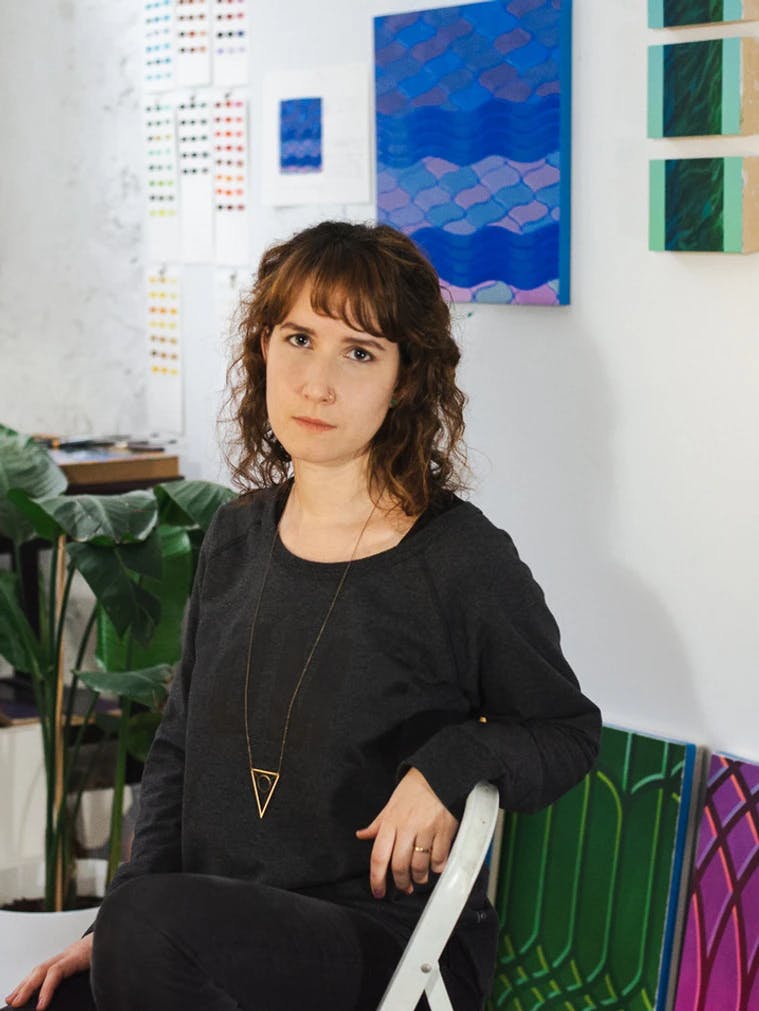
Lucía Rodríguez Pérez on Beauty, Unease & Everything In-Between

We sit down and talk beauty, unease, and everything in between with Lucía Rodríguez Pérez ahead of Guarded Wilds. Read on for our conversation and watch the video here.
Uprise Art: Who are you?
Lucía Rodríguez Pérez: I’m Lucía Rodríguez Pérez and I am a visual artist. I was born and raised in Santiago, Chile, and I've been based in the US for ten years, currently in Brooklyn, New York.
UA: What do you make work about?
LRP: I like to think that my work is about ambiguity. I think that art has the capacity to convey the space between things. And through my painting, I try to explore what exists between language.
UA: When did you start developing this work?
LRP: It's interesting because I think that ideas develop over time. And in a way, when you're younger, you are developing those pieces slowly, and as time goes by, they start coming together. So in a way, the ideas have been brewing for a long time, but I think that they've been coming together in the past five years, and I really felt that change. It's like things got finally channeled, and I felt like I was able to put together all the things that I was interested in.

UA: I think that your practice is very generative. We've known each other over the past couple of years, and I feel like whenever I visit the studio, you're talking about what you're doing, and then you always talk about how it’s already given you an idea for the next piece you want to work on.
How did you begin working in this style and with these materials? Like you said, a lot of this work started crystallizing over the past five years - was there anything that really set that into motion?
LRP: I think that what set that into motion in part, was the pandemic, because I struggled for a long time finding what I wanted to do, but also maybe it was a moment when I felt like I could allow myself to do what I wanted to do.
We were all confronted with this moment of like, ‘what the hell is happening in the world?,’ and that pushed me to make a decision like, ‘you know what? I'm just going to do what I want to do’. I think that I was ready technically as well, after years of learning about drawing and painting, color, and materials. I realized I wanted to keep working with oil paint because of what it can do with color. I think it's very unique. And also I wanted to allow myself to first explore abstraction, and from there, go back to representation with a mindset that mixes the two. I don't see a difference between abstraction and representation in my work.
UA: What role does color play in your work?
LRP: Color is very important for me. I see color as a language in itself. For me, color is the language of ambiguity. I mean, where does yellow end and orange start? I think it is a very useful tool to talk about how things work in relationships, how things are defined in relation to other things in a way that written language or spoken language can't do. Color is the perfect language to remind us what's in between. And I like being in that space, and I like not being scared of that space either, as a human experience. So I think that color connects me with that.


UA: Color in your work is almost the main driver of the narrative over any architectural or floral elements that happen. Given that, what drew you to depicting the things that you do depict?
LRP: I think on one side there's the interest in abstract shape relationships, but on the other side, I've realized over time, there's kind of like a parallel significance in my life. It’s one of those things where you start making the work, and then you realize those connections with the past.
I grew up in a very nice neighborhood, but in Chile, all houses have very tall fences, you know, for like a matter of safety. And in this neighborhood, a lot of people would use plants to make their fences more beautiful, and also to prevent the view from the street. I think that because I walked around the neighborhood a lot, these images stuck in my head, you know, this relationship between the fences and the and the plants. I always thought that there was an interesting tension there between the organic and the manmade.

Also, on a more personal note, when I was a kid, our house got broken into. These guys came with guns, and, it was like a very traumatic experience. But for me, one of the most traumatic parts was that my house used to have a very small fence that was always open, and after that event, my parents changed the fence to a big fence with a buzzer. I think that really got in my head, how that experience changed our relationship with the world.
I remember my mom saying that she refused to have a fence that would block the view, so they decided to get one that was just bars. I thought also it was a very strong statement on her part to say, like, ‘I refuse to live in a cage just because this happened’.
So I think that those ideas and relationships with the world got in my head. And then over time, you start researching and reading and studying and finding other relationships, like the relationship between architectural elements for functionality, but also how ornamentation can make things that are more rigid feel more gentle and incorporated into the space.
I realized that there's always been such a strong interest in making these architectural spaces resemble nature. It's like in a way, that geometry and that harmony is already in nature. And as human beings, we have tried to mimic it. I’m very interested in that idea of like, ‘what's reality?’ How do you depict reality and realism through different materials? How can you create the illusion of nature, but also transcend it.

UA: First of all, that's horrifying. I'm so sorry that happened to you.
LRP: I mean, most of the experience is blocked. I don't remember. And it was my birthday…it was pretty bad. But I don't know, I’m thankful nothing worse happened, you know?
UA: I do think in your work there is kind of this tension between a sense of beauty and also a sense of unease. Do you think that it comes from that formative experience, or do you think it's just something separate that you're just interested in purely on a more narrative level?
LRP: I think that experience fed into that, but I think that's a feeling that I was interested in even before. For example, I’ve always been naturally very attracted to films that were very beautiful but kind of uneasy.
I think beauty helped me to explore the uneasiness with a little bit more trust. Movies like Disney’s Fantasia, you know, it's so beautiful, but there's always something that feels a little strange. I think that I realized that that's something that I was very into. So over time, I've been getting deeper into that, and I really want to convey that in my work. I think that it's an interesting feeling, but I also think it has a function. I think it can invite people to be inside spaces of uneasiness and explore them, and feel like it's not a threat. You don't need to be scared of it. You can actually discover things. You can learn about yourself, about the world, about life, and I think it makes you a more complex person to be there.

UA: Can you describe what's currently driving your practice, what you're excited about, and the works that you're making at this moment?
LRP: I think, as you mentioned before, right now my work has become very generative. It's like, in a way, I found a path in which the research leads itself. I think one of the fascinating things about being an artist is that it's constant research. You're always learning, you're always incorporating new things. That's the fun of it. It's a never-ending process.
Right now I'm very interested in just introducing more elements into my paintings. For a long time I worked with the patterns of these fences. Then I incorporated the plants, and the relationship between them grew. And now I'm thinking about what other elements I can add in there.
For example, I'm working on a painting for the show that has different flowers, and some of those flowers are just the buds and the other flowers are fully open. I think that starts incorporating a sense of time in the work that maybe wasn't so obvious before. And that's something that I like about the natural world - plants are growing and dying at the same time. I'm very excited about that, and I'm also incorporating more complex architectural designs, introducing more ornamentation into the work.
I like to see how these elements relate to one another. I'm excited to see what the boundaries of narrative are. I never want to make overly narrative work, but I think it's good to play around, to explore, to see how you can navigate the spaces in between. That's very exciting for me right now.

UA: I always think about your work as having its own cast of characters that get developed over time. When you add new elements, they're added very thoughtfully, and they're usually not strictly based on 1:1 source material. I feel like the way that you've developed these leaves, they're like a leaf everyone recognizes, but at the same time, they're not a specific leaf, but they are a specific leaf to you. The flowers are developing in that same way. Can you say more about your process in creating these archetypes and your research? Because I know you do a ton of research, read a lot of books, look at a lot of images - how does that seed of the idea translate to what you finally end up putting in the painting?
LRP: I really enjoy the process of figuring out through the work the different elements that I'm working with and how much of these elements are individual or particular and how much is universal. Because again, it's like that space in between. It's like, ‘how much of this leaf is the idea of a leaf? How much of this flower is the idea of a flower’.
I like looking at real plants. I take a lot of pictures, but I also like to look at representations of plants, like how they've been represented throughout art history or botanical illustration throughout time. Because in those works, there's already a level of abstraction that 's been developed to explain the plant in a way.
It's like a medical illustration. It's not the picture of a body, because that would be kind of useless, it's better if you see the explanation. So I like that level of abstraction, how it can inform my work to create these elements that exist only in that world that I'm creating. I'm not interested in depicting something that you could necessarily recognize, like my flowers don't try to be specific flowers. I like the idea of picking and choosing elements of different flowers, and creating my own flowers, because the place that I'm inviting the viewer to see, it's a place that only exists in the painting. And I love that. I think that that's a reason to attract the viewer to look at the work.


UA: Jumping off that, are there specific artists or cultural or historical references that have shaped how you see your work?
LRP: There's a ton. They come from all different mediums, but most of them are visual.
Early Disney movies are very influential. And I think a big part of it is because a lot of those artists had a fine art education. It's very interesting to see how they made that translation from fine art into new media at that time. Their work definitely impacted my sense for color.
I also love traditional Western art. I've been very obsessed with Bronzino lately because he has that eeriness. It's a completely different subject matter, but also, I think he conveys a big part of the eariness through composition and his use of color. So I tried to look at his work, to see how he's doing this, because I feel like it's very economic in a way. He's making these very simple decisions, but they're so well placed in relation to one another that I think there's a lot to learn there.
Also, film. I love film, I love directors that work with visual elements. One of my favorite movies is called The Fall by Tarsem Singh, and I just love it. It's pure visual narrative. I mean, the fact that there's just a difference between what Lee Pace is saying, how the girl is interpreting it, it's just I think what film can do, you know, and I think it's a very pictorial way of thinking about film..so that, among others. I could keep going!

UA: What kind of conversation do you hope that your work enters into?
LRP: I think what I mentioned before, in terms of ambiguity and how things are sometimes relative. I think we are in a time where there's pressure to find absolute truths. In the way I see it, things change and then it depends. It's more useful to have a conversation than to find an absolute statement. I hope my work can convey a sense of silence, the importance to stop, to listen, to also listen to yourself, you know, to not be so eager to maybe say something to somebody else, but to explore what it is that you are thinking that you're feeling? What are your own fears that maybe you're projecting on other people? I think that for that you need silence. So I'm hoping my work can bring that to people to hopefully encourage conversations that come from a space of calm, you know?
UA: Yeah, definitely. I definitely feel like I'm in a peaceful, soundless space whenever I see your work. I think there's some work you look at and you feel like you can almost hear something or smell something, and have a very visceral sensory experience. But with your work, I do get that sense of solitude.
LRP: I mean, I think I do it in part also for myself. I have a very active mind, not always in the best way, and I think art, especially painting, because it requires so much focus, has been the only space where I can feel that silence. It brings me a lot of peace.

UA: Speaking to moments of pause, earlier we were talking about how in this green painting, there's more left “unfinished” than you would typically maybe render in other works. Could you talk about that direction in your work?
LRP: I think something that I've struggled with technically throughout my development as an artist is how much to render, how much to define something, because at some point things start feeling stiff and over-controlled. I think that I tend to control things to feel a sense of calm and security. A lot of times, paintings actually work better if you just let it be, let it be unfinished, let it suggest something. It's been nice to allow myself to step back. And I think it contributes to the viewer’s experience to be able to complete the image on their own. So again, that's very conceptually tied to what I'm saying that I want to do. It's been a great discovery. It's been about allowing myself to do things that intuitively, I know would work better, but my irrational side is trying to control.
UA: While we're on a technical note, can you talk about the process of creating a painting from the ideation to the sketch to getting it on the canvas?
LRP: I think the ideation varies. Sometimes I see it in my mind, but that seeing it is not very specific. It's more like, I see maybe the rough composition and the idea of the tension that I want to create. I think for this green painting, I kind of saw it in my mind one day, and I was like, I know what I want to do.
But then there's a process of visualizing that and seeing if it actually works. Usually what I do first is a very rough sketch, like a thumbnail. Then after that, I usually go to the canvas, and I start just placing the different elements. And when there are certain elements of the painting that I am not completely sure how I'm going to solve, I go back to the paper, and I look at a lot of references. I ask myself, ‘how is this photograph working? How does this element work in this illustration?’ I need to just sketch and try things. And when I feel a little bit better about it, I can go back to the painting.
I also repaint a lot. Sometimes I try one solution. It doesn't work out. So then I go to the next one. And I think that's also important for me to let myself change my mind on the canvas. I think the most difficult moment is right before the color palette locks in. For color palettes, I have a bit of an idea of what I want to do. I pick my pigments, and then I sometimes go to my color charts to see if I need to incorporate something different. There’s the most tension when things are not quite there, but then at some point things make sense. And that's when it's just all fun, you know, then you're just building light and finishing things and creating a sense of volume.

UA: What directions are you excited to explore next?
LRP: I think I would love to work in different mediums. Like, I would love to have the chance to make reliefs. Maybe work on a bigger scale as well, and eventually maybe work on a film, maybe something short, you know?
Once you are a painter, you always think like a painter, no matter what the medium, so I’d be very curious to see how my background as a painter would impact the way I explore these different mediums and then how that would feed back into the paintings, too.
UA: I know you have some residencies coming up, too. Do you have specific plans for what you want to do there?
LRP: I have a residency at the Vermont Studio Center. For that residency, I will probably focus on drawing because I’ve been painting more lately. I want to go back to drawing. It's a comfortable space to work. Also, residencies, even if they are month-long. It's not a lot of time. So I think with drawing, I can go a little faster. I'm also planning on doing one painting that I already have planned out, and I will probably take it there with at least a sketch on the canvas already so I can just finish it there.
I think that residencies are a great space to create community, but also to display what you can do as an artist. Seeing the work in person is so important. It's so great that we have the whole digital world where people can see images, but it's very different to see the work in person. So, I'm excited about doing an oil painting there.
At the end of the year, I have another residency in Sardinia, Italy at Nocefresca. For that one, I want to focus more on research, because I'm going to be in a new environment with different nature, different architecture. I think I'll take a lot of pictures, do a lot of sketches, probably do a couple of paintings, maybe some paintings on paper. But it will all be about gathering visual elements and growing my visual vocabulary.

Published August 2026