Damien Davis for Black History Month

Damien Davis welcomes us into his studio to discuss the merits of visibility, the honesty of materials, building a sustainable art practice, and coding Blackness. Read the full transcription of our conversation below and watch the video here.

Uprise Art: Who are you?
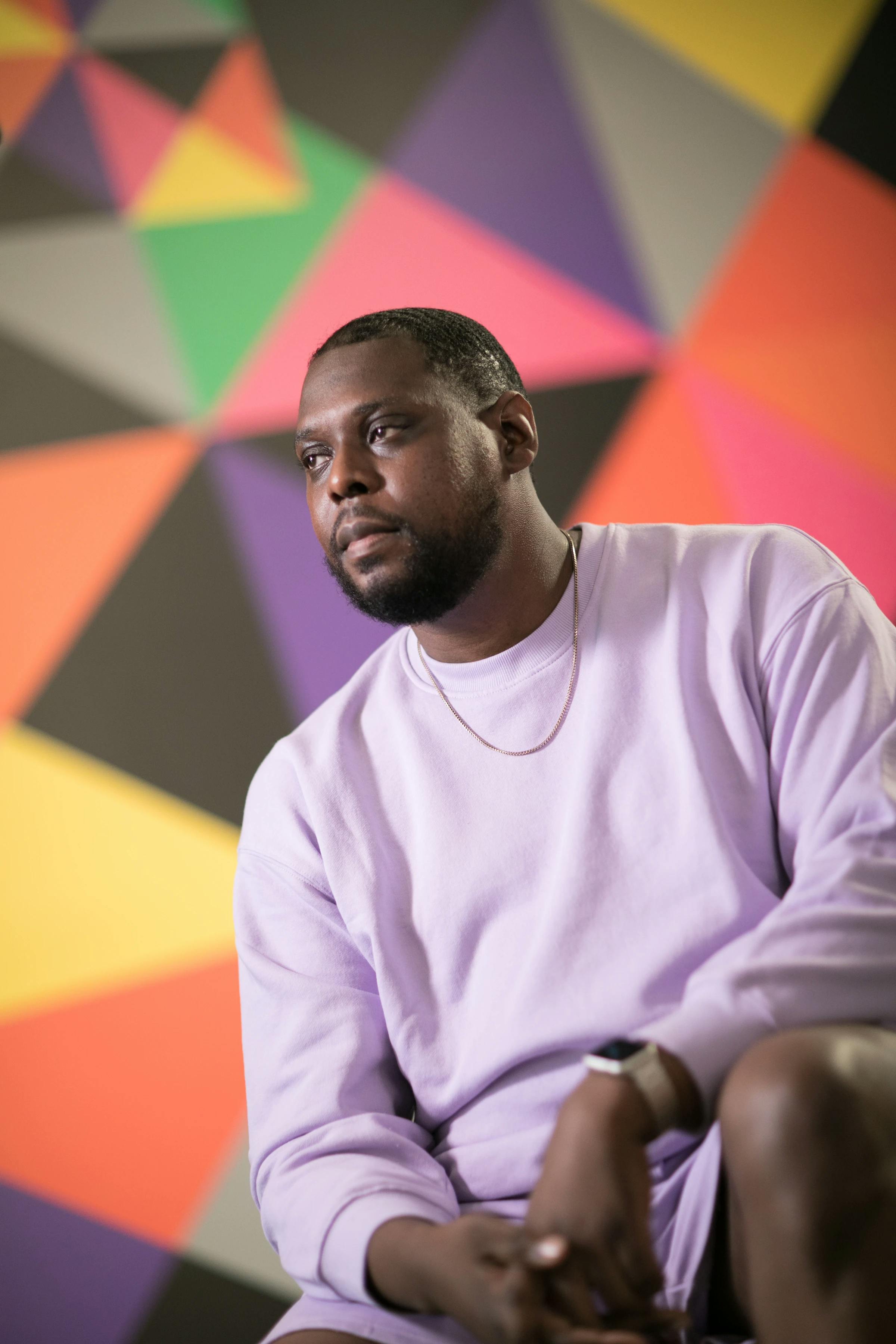
Damien Davis: My name is Damien Davis. I'm an artist, educator, and writer based in Newark, New Jersey. I was born in Crowley, Louisiana, raised in Phoenix, Arizona, lived in New York for 20 years, and now I'm here - so I'm a bit on the nomadic side. All these labels feel so scary to assign to myself. I don't know, I think that's a perpetual thing for creative folks - fully identifying with that word, or multiple words in this case.
UA: Luckily, ‘artist’ can be a broad umbrella and container for a lot of things.
DD: I’ve been called worse things in my life, so it's okay.
UA: When did you start developing this work? You have a couple of different bodies of work, so you can talk about them broadly, or you can talk specifically about certain pieces.

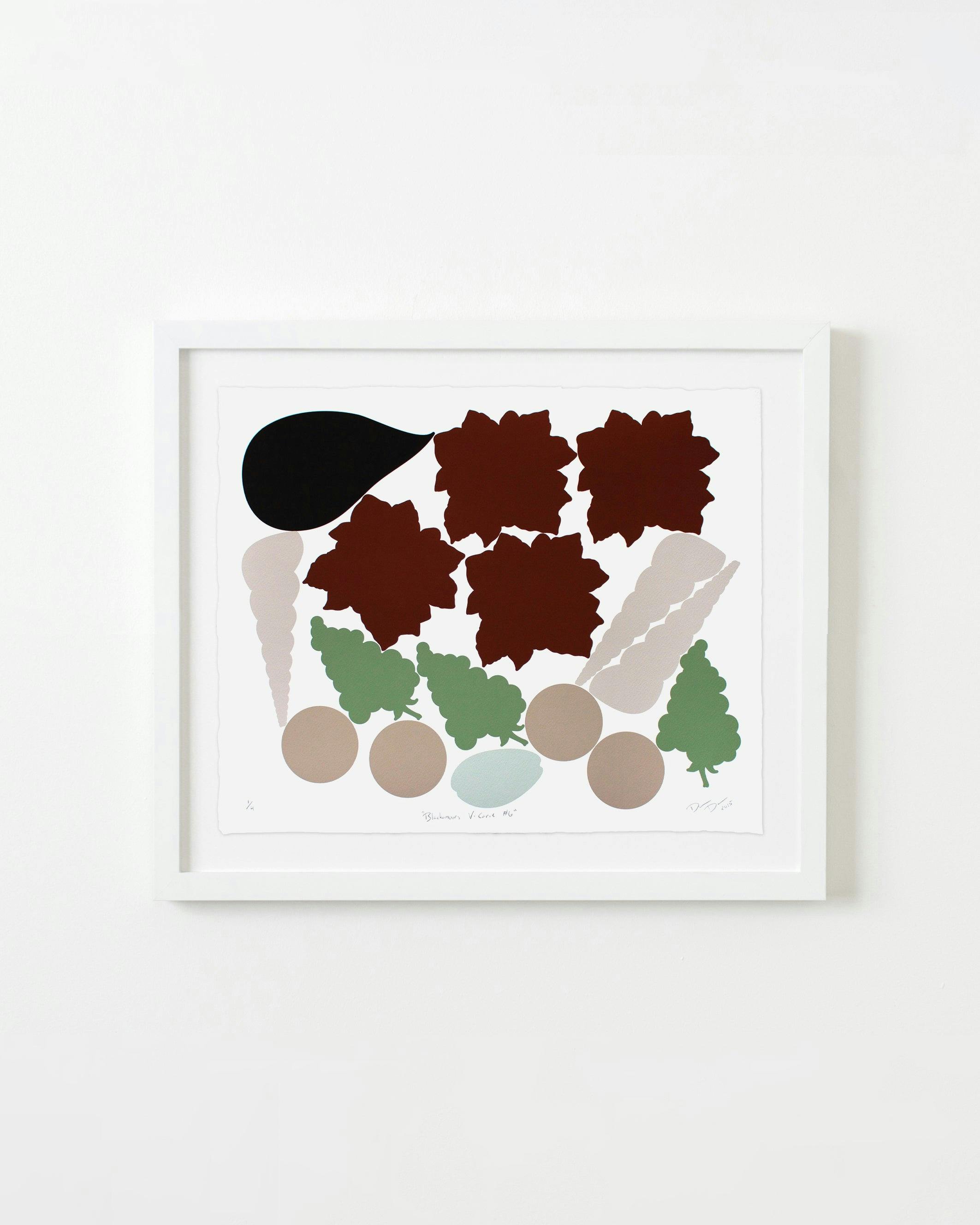
DD: I'm really interested in research-based projects. I like this idea that whatever I'm interested in can kind of take a life of its own. From a material perspective, I've been doing this stuff with laser-cut acrylic for, my goodness, maybe like 12 years now. In college and after, I was always interested in Adobe Illustrator - lines, vectors, and geometry. For a long time, the work existed in the computer, and I was totally fine with that. And the thing that I say to people all the time is that the technology in some ways, caught up with the work I was doing because all of a sudden these mathematical equations that sat in the computer could be pushed out through a laser cutter, through a 3D-printer, through a CNC mill - all these things that allowed for this flexibility in a material approach, but still have that same kind of aesthetic sensibility to what I'm doing. The hardware part of it has always been there as well.
I really like the honesty of it. I like this idea that the thing that pierces through is also the thing that holds it together.
This idea that the work itself feels assembled or made in a way that doesn't subscribe to romanticized ideas of what art making looks like. So, the way that we as a society or as art lovers romanticize a brushstroke doesn't necessarily exist with this work. It's hopefully trying to romanticize or aestheticize a way or means of production that feels almost blue collar or mechanical - like you might not be able to imagine yourself as a painter, but you can imagine yourself turning a wingnut, so there's something about accessibility with that process that feels really important to me.


With the paper (which I guess is sort of a new thing, but also sort of an old thing), I like that it's functioning in the same language, and the process is very similar. The glue thing is freaking me out a little bit. I have to say this, this idea of, like, using goopy things is not something that I've done for a long time, because I also really like the idea that something that I make could theoretically be taken apart and reassembled or reconfigured into something else. So, the paper collages feel permanent in a way that makes me a little anxious.

UA: How did you start working with acrylic, specifically? Were you drawn to it for its utilitarian accessibility, like with the wingnuts? Or was it more that you encountered the material and thought, 'Oh, I’m interested in seeing what I can do with this and how I can translate what I’m doing two-dimensionally on the computer into acrylic'?
DD: It was almost accidental in a way. I was working at an art school, and we had recently acquired this laser cutter, which was a relatively new piece of technology at the time, and no one wanted to learn how to use it in order to teach the students how to use it. So I wound up being that person, and through that process, I kind of figured out how, well, it played with my existing work, and the acrylic was something that was the most immediate thing at the time.


I had sort of stepped back from being an artist for close to a decade by that point, and a friend had invited me to participate in this quarterly night of performance art. And at the time, I didn't necessarily know what to do, but I knew that I had the stuff that I built on the computer. I had this new skill, knowing how to use this laser cutter and then this material that felt fresh and open. This idea of using technological devices to mediate what I'm thinking or feeling into a physical form is also something that's been really important for me as a maker. And I think it kind of speaks to larger conversations of what it means to be.
There's always been this larger conversation for me in the back of my mind about what it means to exist in a body that's politicized in ways that I don't have any control over. And what does it mean to use technology to mediate my work and my thoughts in a way that hopefully makes that humanity more legible? Is there a way that I can use technology to get people see me as more human than they might perceive me to be on a regular basis when I’m just walking down the street?
And I think this speaks to this larger conversation we're having about Black History Month and what it means to celebrate this time and this history.
And I'll be very honest, you know, I was having some internal debates about even just this whole conversation, like, what does it mean to put on the performance of being a Black person during Black History Month, but it also feels more important than ever to be doing that when our history is under siege - when our history is actively being erased or smudged or withheld. The more that we do to celebrate our humanity, the more that we do to make our humanity legible to people that are actively resistant to seeing it, I think, is important right now. I think that there's always been this hopefulness that celebratory months or weeks or holidays will be less necessary as time moves forward. And the cyclical nature of how humans operate, at least for me, is just kind of reinforcing this idea that these things are always going to be important. And it's something that's been present in my work for a long time.

I've always been interested in these histories that have been smudged or erased, historical figures that are sometimes lost to time or to history, or we're actively being told are not important or things that we shouldn't be celebrating. I try to celebrate that as much as I can with the work, but the work is also designed to… how would I say it? The work is designed to invite speculation or inquiry before fully revealing the intentions that I might be importing into the work. And what I mean when I say that is like, you know, it's shiny, it's sparkly, it maybe feels a little bit happy. You're drawn in by the aesthetic of the thing. The materials feel familiar to you, the process, the way that the thing is made feels familiar to you in some way. So it feels less confrontational at first.
I like this idea that the work can be confrontational without presenting itself at first blush as confrontational.
UA: I liked what you were saying about, you know, how there is something about the work that invites you in. It's colorful, it's plastic. It looks like something you want to touch - to see how it works. And then once you've kind of encountered that, you can further excavate what's happening in the piece, the symbols that you're referencing. Can you talk a little bit more about that, because I know that you use a lot of these recurring motifs, whether it's the afro pick or the cowrie shell, these African masks - what are some other symbols or cultural identity markers or, you know, even other artists that you're pulling into the work when you're creating?

DD: For me, it all comes down to time in this weird way. So there's the way time manifests itself in the materials, because I'm drawn primarily to plastic, metal and wood. Wood is the oldest material that we as humans have in terms of toolmaking. And then you have metal from the Industrial Age that becomes this other way of producing tools, for fabrication. And then the plastic is interesting because it didn't come into popular use until around the 60’s.
We started using plastic en masse around the same time as the Civil Rights Movement and the Gay Liberation Movement. So there's something about the way this material is anchored by a specific point in history that's really fascinating to me.
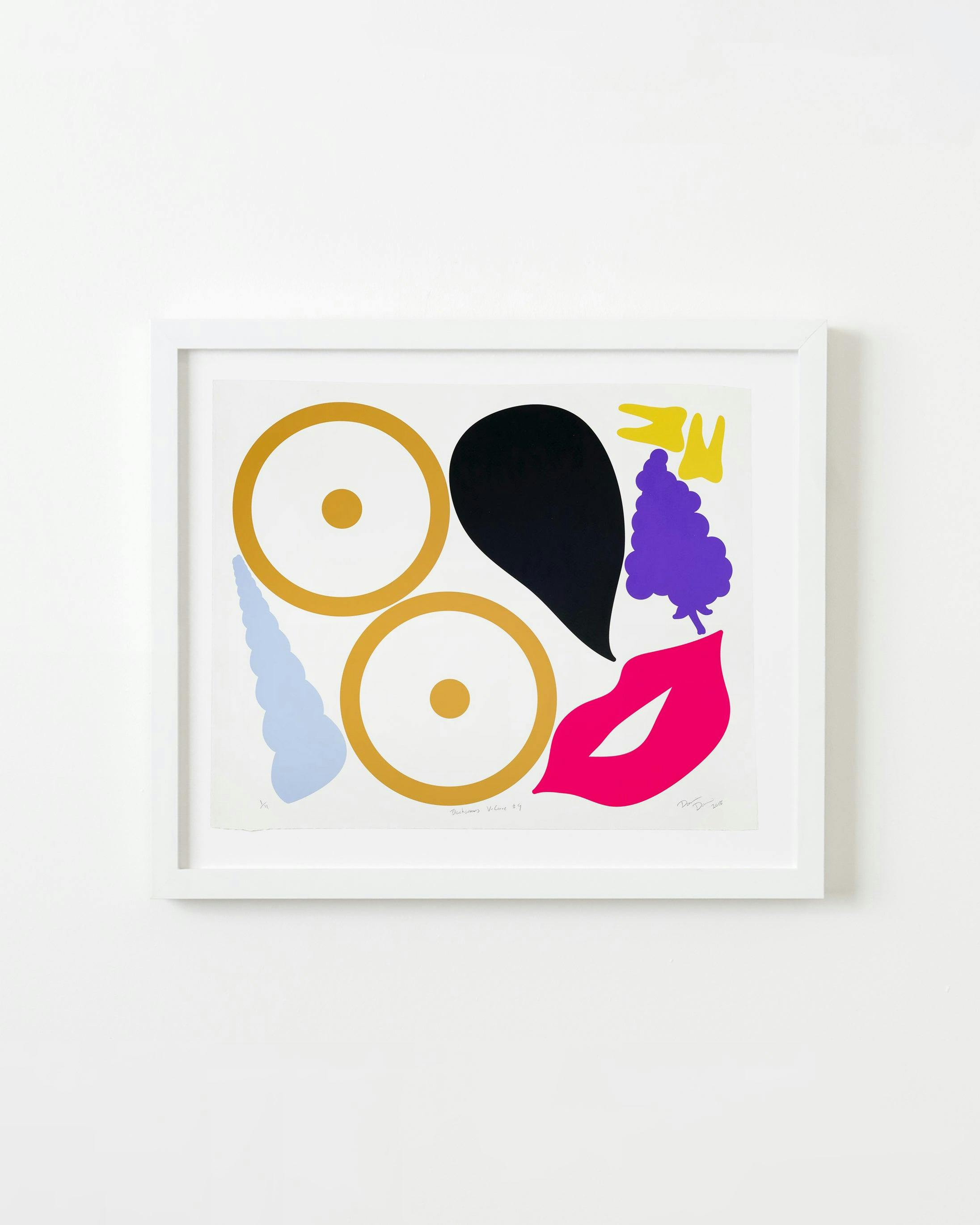
And then the symbols are also pulled from those different eras of history. So some of the symbols are really old, so it might be like cowrie shells, for example, which were a very old form of currency in Africa. It might be, something more from the Industrial Age. Again, I'll pull in the mask itself. But then the materials come from a more contemporary time, and the shapes, like the Afro pick, for example. There's a couple iterations of it here, one where exists on this rocket ship mask and then this larger version, just on its own, this idea that the shapes are pulled from, like really old ancient history, popular culture, contemporary narratives. Nothing necessarily feels off the table for me, but the development of these shapes is something that’s extremely slow.

And again, it's kind of born out of the research. I like this idea that I'm mining history to pull all these different shapes into existence or into my personal lexicon, and then it's about constantly testing the limits of what these individual shapes are capable of doing narratively, and those gaps where that library can't do the work, is where the development of new shapes form.
The shapes are always pulled from the ways in which Blackness has been coded, decoded, or recoded throughout history.
When we're talking about certain areas of history, that language is also very much steeped in currency. That's something that's been an undercurrent for the work for a very long time. Like social currency, emotional currency, sexual currency, people as currency.
That's something that's informed where these shapes come from. I mean, I can, like, go on about individual shapes, but I also like the idea that they kind of function as clouds in a way, or that's the way I like to think of them, you know, or even as prisms. I might be importing all of this meaning and these ideas into a specific shape, but I like the idea that it comes out as a myriad of things that can be interpreted by the viewer as whatever they want. So, part of the way I make my work is about doing this research, trying to distill that research into a singular shape, but then letting the ambiguity of that shape just do the work. For the viewer, hopefully, if I'm doing my job correctly, you are trying to reconcile what all of these different shapes mean in relation to each other. And there's maybe something that's revealed about the way that you see the world and the way that you're making these leaps in logic, that makes you realize, like, ‘Oh, yeah, I'm not as unbiased a viewer as I might give myself credit to be’.

And that's really what I'm hoping the work does on a larger scale, is just to expose the fact that language is complicated. Language is extremely messy. It's imperfect. But I also think that sitting in that imperfection offers all this space for us to see the humanity in each other. If we're giving language the space to do that. I was just watching some clip of some talking heads on CNN, and it's soul-crushing because it's just people talking over each other and no one's giving the space to, like, actually hear, listen, process, understand. And whenever I see those videos, I always think to myself, like, how much better of a world would it be if we actually gave each other the space to just hear what other people are saying? And the goal with this work is to slow down that process of listening enough for people to give themselves permission to listen, and also give themselves permission to listen to other people.
UA: What questions or tensions feel most alive in your work at the moment?
DD: That's a good question. I think if I'm answering that honestly, the thing that I'm struggling with right now is just, what can the work actually do? And what I mean when I say that is, you know, I think that we are coming out of this 2020-era of history where people, at the very least, put on the performance of being interested in forward thinking and having forward movement. But the thing I say to people all the time is, I think people really just learn how to put on a better performance during those protests and those activations and stuff. So now, if we're in 2026 and people are simultaneously exhausted of putting on the performance, clearly have no interest in putting on that performance, people can see through the performance, and people understand the language of that performance. Is there any actual performance left to do? And what I mean when I say that it's like, can I trust the work to perform in these specific ways? Or, should I be pivoting and shifting into a way of working where I'm not asking the work to perform? Maybe I'm asking the work to just, like, exist?
I come from a family of educators; everyone on my mom's side of the family grew up to be a teacher, and then I wound up being a teacher. That kind of work and that kind of labor is something that I can't necessarily get out of my system. But I also wonder if I may be doing myself a disservice just as a human being, by expecting the work to perform, to teach, and to educate. And that's where this brushstroke series comes from. I've been enjoying making work that's about just existing, but also still thinking about these ideas of labor, like how labor is performed, how we value labor. Again, this idea of the brushstroke being this form of artistic labor that's really fetishized. But the reality is, I'm making something that looks like a brushstroke. It's not actually a brushstroke at all. It's this very meticulous work on the computer that then gets pushed out by these machines and is assembled by hand in a way that doesn't resemble painting at all, but it's also still acrylic on a substrate. So does that technically make it a painting? Like in an academic sense? I don't know.

I like this idea that all of these things are sitting in conflict with each other, and maybe that's the tension that I'm enjoying right now.
But for me, we're in a weird time where there's also this deep sense of guilt, I guess, about being an artist in the studio, at least for me, because the question then becomes like, are there other forms of work that I should be doing that are more important? But then I have to go back and think to about the things that I say to my students all the time, which is, you know, you don't know how important it might be for someone to just see you existing. And again, this goes back to Black History Month. Like, it might be just really important for someone to see me existing in this body, in this space, using these types of machines, making this type of work. Like somebody might need to see that in order to find their own sense of self or a sense of purpose. I'm trying to trust in that as much as I can.

This is a very elaborate way of me saying I am very lost. I don't know what's going on, but I also think that's maybe the best place to be in when you're in the studio. If I were in the studio and I knew exactly what was going on, and I felt like I had a grip on everything, I would probably feel like a failure for a slew of other reasons. I think as artists, not knowing what's going on, having the presence of mind to say, like, ‘I'm not sure this might not work, I have no clue what I'm doing, I have no clue what the fuck I’m doing’. I think that all that's important, especially in a world where, like, no one knows what's going on. No one knows what they're doing. Very few people are willing to admit that they don't know what they're doing, but they're still doing those things. Maybe there's some bravery in just being honest about that.
UA: For me, I see that as a really important part of being an artist. And I think an essential part about being an artist, because if that unknown wasn't part of the journey (which obviously, is a not so fun part of the journey), it just would be mechanized. And if it was mechanized, it wouldn't be art. And yeah, not that there needs to be like pain and suffering in order for good art to happen, but I just think that sitting in the unknown sometimes leads to something important in the end.
DD: Yeah, my big thing in 2026 is less pain and suffering, but more discomfort.
And what I mean when I say that is, I think as artists, we should constantly be chasing discomfort. The thing that scares you, the thing that makes you feel small or stupid or unsure, in my opinion, is actually where the work is.
And there's been so many instances in my career where running towards the discomfort has been the most fruitful thing.
Like for example, I told myself for many years that I hate children, and then I did a residency at a children's museum, and it just blew my mind because there are these little people that you think don't know anything, and they're reading you to filth, and like, ‘I don't like this. This looks dumb. Why is this here? Why is this that color?’ And you have to defend that. But then at the same time, when you're in close proximity to them, you realize all these things that you lose as you get older, you lose your curiosity, you lose your openness, you lose your willingness to try new things, to learn, to understand. And again, it's another thing that if we all just paid attention to this thing that we're losing as we get older and tried harder to hold on to, maybe the world would just be a slightly better place. We should be uncomfortable.

UA: And I think too, as you said earlier, thinking about children, thinking about other people seeing you making art, being like, I could do that - is important. But I also think that question of visibility, especially in a time like Black History Month, can feel icky. It can feel like ‘Look we’re the gallery patting ourselves on the back for showing that we work with Black artists’. But, you know, it can also be like, look at this amazing artist that we work with. Let’s intentionally make this time to reflect on these artists that live contemporaneously, and these artists that have come before them, that we don't give the same credence to as the predominantly white artists that we see in history books.
DD: Yeah, no, totally. I think that there, and I'll be very honest, I think that there have been years in the past where the thought of Black History Month programming makes me want to roll my eyes, and at the same time, I do very strongly believe every month should be Black History Month. Every month should be every kind of history month, in my opinion. And that's the way that I try to structure my life as best I can.
But then also, to assertively create programming or moments for this, given everything that we're in right now, feels like the most subversive thing. It feels like the thing that we need to be doing. Otherwise, people wouldn't be so aggressively trying to stamp out this history.
And I know for me, a big reason why I'm even doing any of all this, is because of my own exposure to that history. I had a mentor in high school, Doctor Eugene Grigsby. If he were still alive, he'd probably be like 110 by now or something. But when he was young, he was a protege of all these Harlem Renaissance painters, like Aaron Douglas and Henry Ossawa Tanner. And I remember as a kid, he would invite me and my mom to his house, and he would show us these paintings of those artists. And he was the one to encourage me to go to New York and try to be an artist. And I don't know, if I didn't have that exposure, if I would have given myself permission to even think that any of these things were possible.
And that's the thing that I constantly am reminding myself of, that, like, again, people seeing you just existing might be the thing that gives them permission to be themselves. And I think that that's a really powerful thing.

And I've been really fortunate to have some full-circle moments. Aaron Douglas is a big inspiration for me because he's a hard-edge painter. And again, it's about symbolism, lines, shape - interactions of color. And I've been largely influenced by that in the way that I structure and make my work. Back in 2020, Columbia University put on an exhibition that was a celebration of the 100th anniversary of the Harlem Renaissance, and they put my work next to Aaron Douglas. And I was like, yes, this is what it's supposed to be. I think this idea that, maybe like 100 years from now, someone's going to look at what I'm doing, which I'm hoping is a continuation of that legacy of those artists, and they keep that moving. That is kind of one of those markers of success for me, is that, again, me just existing offers an opportunity for people to not only see themselves, but give themselves permission to be themselves.
UA: Absolutely. Going back to what you were talking about, transitioning from works with the more overt symbolism to the brushstroke pieces that are grappling with these different parts of your identity. You know, your identity as an artist, your identity as a Black man, your identity as a queer man. What part of your identity are you excited to put forth in the new work that you're making? Or what are you just excited about in the new work in general?


DD: I think just the freedom of it. You know, for a long time, I had convinced myself that the work had to do more than just be work. And giving myself permission to let the work just be work, is something that's taken a lot of work.
Something that's still functioning in this process, in these materials and these aesthetics. But is not necessarily grounded in history in the same way. It might be more grounded in poetry or color, line or shape - or abstraction. I think that there's this long history of Black abstract artists that I also feel a lineage to, and I want to explore that for a little bit. I'm in this weird moment now where I'm trying to reconcile the abstraction with these shapes, and I'm wondering if they can coexist or if they need to be jettisoned - but it's also happening at the same time that these new collages are happening. It's like a lot of different things and different feelings colliding at the same time. And they're scary because I don't know what's happening. But again, that's a good thing.

UA: One thing I was enjoying about looking at the collages is the way that you have the different shapes, kind of interlocking to each other, like how this black swish comes over top of the blue mark, and then it has the pink mark tucked away underneath it, which having forms intersect doesn't obviously feel like a new thing for your work. But maybe the nimbleness of paper is, I think, a new thing that I'm excited to see the different connections that come of, just the way that you're able to handle the materials. And I know you're nervous about the gloopy glue, but…

DD: It's so gross to me. I can't handle it. But also, it is new. This idea of weaving paper together is something that I guess could theoretically happen with the acrylic if I used heat and manipulated it in specific ways. But, the acrylic work has always been about stacking and layering, and it having some sort of subtle architectural components to it. This feels more, well, it's obviously weaving, but then it feels more like a tapestry in a way. I've definitely worked with fabric in the past, and I've made things out of fabric, but… and that might actually be the thing that I'm not accepting is that the material and the way that the material is behaving is probably closer to fabric than the acrylic, and I've been trying to think of it in those terms.
My dad was an electrician, and my mom was a Home Ec. teacher for 30 years. I find that my practice is always merging one of those two things, like my interest in technology, circuits, and systems, comes from my dad. But then also this interest in how people relate to each other, how people care for each other, how you care for objects - the way that you can import care into an object, that's always come from my mother.
I've always liked this idea that the acrylic pieces sometimes feel like quilts, because it feels like I'm suturing these different objects together in some way. But that's also been another sort of tension point for me for a long time.
This idea that I'm drawn to processes and materials that tend to be prescribed as sort of super masculine or super feminine, and that's something that has always bothered me in a weird way, because I don't personally see these things as masculine or feminine. I see them as just things - the same way I see myself. I see myself just existing in the space, but not the way that people want to prescribe those words and those terms onto me - that is something that I can't stand.
So yeah, I think that might be what's happening with these collages, and that might be what's scaring me about them is that it's maybe forcing me to confront, just through the way that the materials behave, the way that we prescribe these gendered meanings onto them.
UA: What’s next?
DD: I've been very excited to get my studio organized. I’ve been slowly developing this very elaborate system to organize my scraps and stuff. It's still not as obsessively organized as I would prefer, but we're slowly getting there. I have…this is the thing…I was, like, kind of nervous, like, are they going to think I'm insane? I mean, they already know I am, so it's fine. But yeah, I've been making all these little labels that are going to hang off these wire shelves because I am psychotic.

UA: I saw your very professional ‘Do Not Touch’ sign.
DD: Oh yeah. No one ever pays attention to it. Everything will soon be obnoxiously labeled in here. And I'm going to enjoy every second of it.

UA: I'm thrilled for that. I mean, I already get such peace and joy from seeing the scraps organized by color, by shape, by amount of material that's already been taken out of them.
DD: Yeah, well, I also like the idea that it gives the impression that I have my life together, which is very far from the actual truth. So, people come in here, and they're like, ‘it's so organized’, and, I'm like, I'm glad you think so, because my life isn't!

UA: You're running a good ruse. You know, it's very convincing.
DD: We’ve got to keep the charade going as long as we can. But yeah, other than that, I don't know. I think that, like a lot of people, I am trying to find more balance in my life right now. I'm trying to remove sources of stress. And, you know, I used to be the kind of artist that would work myself so hard I would wind up in the ICU. There were maybe a few times I worked myself so hard I was at death's door - literally. And I'm trying not to do that in the new year. I'm trying to go to the gym, live a more centered life, and get home at a reasonable hour. And I think that that has become just as, if not more important than, what goes on in the studio. I'm really interested in this idea that art or maintaining an artistic practice has to be about tending to the totality of a person. You know, art is supposed to be the thing that happens in between the living. I have to make sure that I'm properly living.
UA: Yeah, after all, art is the expression of the artist. And if the artist is not in good working order, the art cannot happen.
DD: Yeah, it just becomes this, like echo chamber. I've been in moments in my career where I'm so focused on being in the studio, there's not enough generative things happening for new thought to exist. And as artists, you have to give yourself time and space for new thoughts to emerge, for complicated thoughts, for uncomfortable thoughts. Otherwise, the work just sort of stays kind of stagnant. And again, if me just existing is going to be a big part of the work, I gotta make sure I'm doing it in a way that's healthy.
UA: And sustainable.
DD: Yeah. You know, eat your oatmeal, everyone. You know, I always thought oatmeal was kind of nasty, but…yeah, maybe Greek yogurt. There we go.