More Is More: Sarah Ingraham

The Brooklyn painter on following her instincts, her love of intense color, and the joy of wanting even more.
Watch the video here and read our full conversation below.
Uprise Art: Who are you?
Sarah Ingraham: My name is Sarah Ingraham. I'm a textile artist and acrylic painter living in Brooklyn, New York. I grew up in Maine, so I spent a lot of time alone, a lot of time using my hands, exploring the woods. I was definitely a very introverted kid, but I liked it that way - and I still kind of like it that way. I spend a lot of time alone in the studio, which is great - a lot of time to think. I think that's the big appeal in being an artist for me.
UA: When did you start making this body of work, or work in this vein?

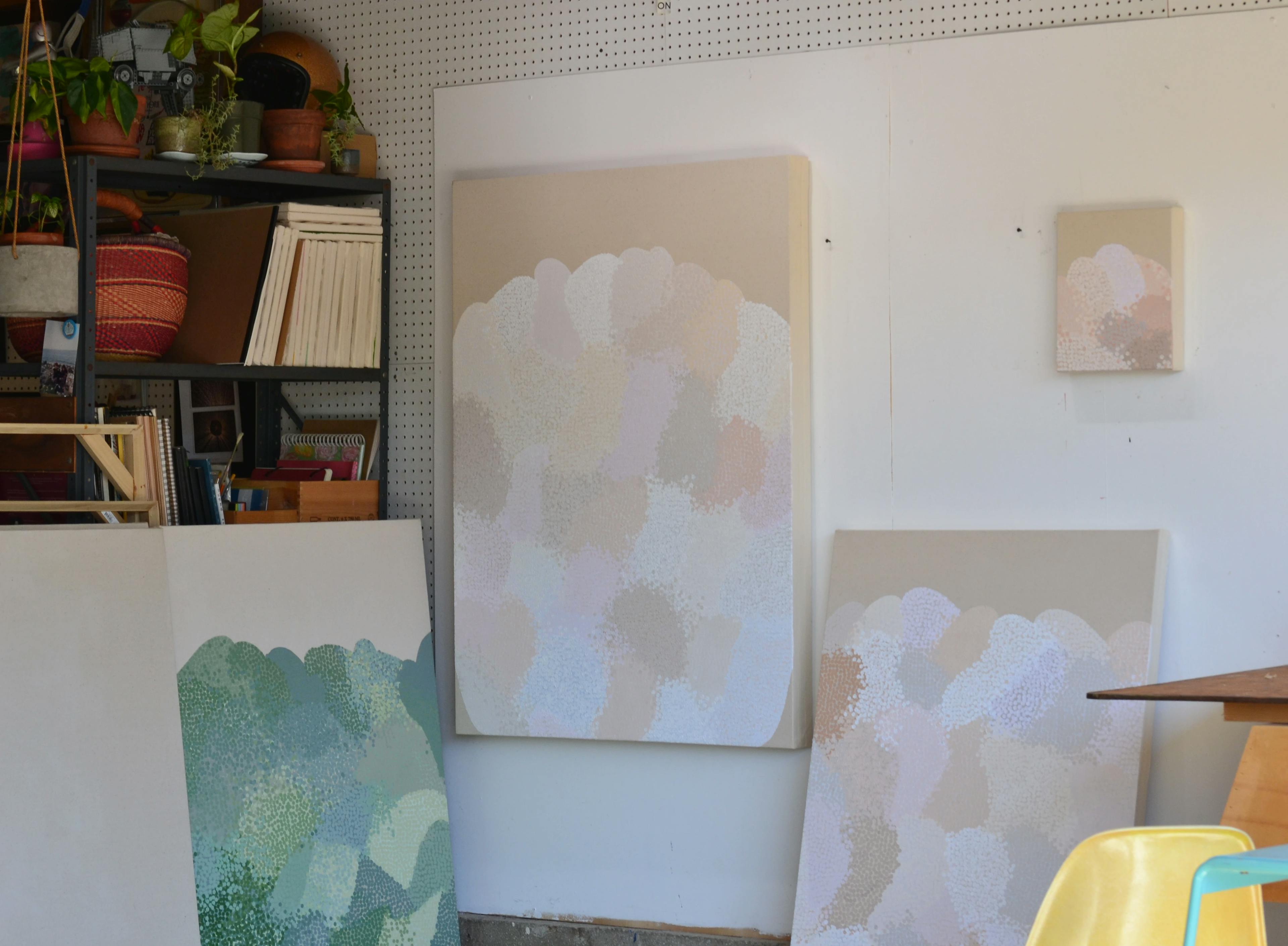
SI: I've always been making things, but I think it's kind of always been about color for me. I could be painting anything, but it's like... if it has no color, it has no meaning to me. A lot of my stuff - it is flowers - it is objects, but they're more like shapes to me, and they're just opportunities to move things around, add color - create a certain kind of vibration. A lot of it is pairing colors and trying to create as much contrast as possible while also maintaining a kind of balance. So yeah, color, balance, a little bit of chaos… I like to overdo it.
UA: Can you talk more about maximalism in your work? That's definitely something that I've seen throughout your paintings, throughout your sculptural work, throughout the tufted pieces. There's always a lot of pattern and always a lot of color - and it's all kind of jammed in.

SI: So, the really jammed-in compositions and the patterns and the colors - a lot of it comes from my experience as a wallpaper printer. We were dealing with patterns all the time, and I definitely absorbed a lot of that, but also I think I'm a person who needs like a ton of input, whether that's like sound, texture, or color… so for me, it's really engaging and makes my brain feel good, you know, to have a lot going on. I just need it to focus and feel in my body.
UA: What's currently driving your practice? Are there some things that you've been excited about exploring recently?
SI: Recently, I think it's literally just been about survival. I just have to show up here and just, you know, go somewhere and feel good. I don't like starting a painting, and I don't like ending a painting, but I really like the in-between when I'm working and listening to a book or a spooky podcast, and I can just really leave my body and make decisions on autopilot. That's when I think I make the most genuine or most important color choices happen. It's about just being in the moment and really feeling good. It is kind of a compulsion, so that's what I think drives the work - it's really just me needing to show up every day and feel good.

UA: Are there any questions or tensions that feel most alive in your work right now? I know that one of the last times that I came to visit your studio, you were talking about using color in a way that was maybe uncomfortable, like creating some pairings and vibrations in a way that almost had this unsettling quality. I don't know if that's something you’re still exploring or if other things have come up since then. I feel like this window motif is like a little bit of a new thing in your work.
SI: It's a little softer - I think I try to pare it down sometimes, and I try to make my compositions and color like…more normal, and then I just end up feeling like I don't feel anything. I don't know! I've also been having this whole woo-woo moment, and I'm really leaning into vibrations and energy stuff now, and I feel like the color is totally a direct relationship. Certain colors hold certain emotions and make you feel certain things.
UA: Can you talk a little bit more about that? Color, energy work - however you want to call it. Maybe specifically about how you now are thinking about certain colors energy-wise differently than you were before..or maybe what some of those colors mean for you?

SI: I'm really thinking about color unconsciously - I think there are just certain ones that I'm drawn to. I try to change my palette, but some of these decisions are kind of inevitable. Especially when I'm in that workflow - I'm not really thinking; I'm just making decisions, and it is a surprise to me every time. When I'm planning a painting, I think about what I want to make, but then when I'm making it, it's not like I actually decide what's happening; it's just unconscious. I’m just drawn to certain colors; I really like when they're intense.
UA: How much of your paintings are pre-planned before you get to the canvas, and how much happens just intuitively once you’re working?
SI: With a lot of the work, I have an image in my mind's eye of what I want, and then I sketch it all out; I put the lines down, and then I go through color by color - kind of like a screen printer - and it just emerges as I go. There's not a lot of pre-planning, but just like this image in my head that I'm wanting to get out. But you know, the process and results are always a surprise to me, and that's why I like being in the middle of the painting because that's where I'm the most optimistic or the most excited. Everything that I want to happen is possible. But then at the end, it's always like a whoa, you know.

UA: Do you find that you change your mind a lot during the process of painting? Like, do you ever paint over things in a different color, or totally just change the pattern and start from scratch?
SI: So, I used to change the colors a lot. And then I found that usually the first pass, and my first intuition, is always the best one. So now I don't spend a lot of time second-guessing my choices when it comes to color.
UA: I think too, one of the things that I really like about your paintings is that you usually will start with a colored ground and then everything builds on top of that. And while you are, for the most part, working pretty opaquely, there are moments where you can see the color underneath. I'm looking specifically at the one behind you where you can see the blue kind of coming through the pink. I think that really activates the pink in a way that is different than if you had painted that pink totally opaquely or if there was another color underneath it, and I really like that. Do you think about those relationships specifically before you start the painting, or is that something that just happens as part of the process?


SI: I think when I put paint down, how it shows up on the canvas is always a surprise. There's not a lot of planning, and that's the fun part. When I go layer by layer, I am always kind of thinking of the next color based on the one that I'm using now. So usually it's like a blue and a different kind of blue or, you know, contrasting colors. I love an orange and a purple, but it is something that I have the initial thought of, and then I just hold on to it because I know that that's the correct next step, and I can't overanalyze it.
UA: I'm impressed by that because there's so much going on in all of these; I’d think that a lot more planning is happening first. Are there any materials or processes that feel especially important to you right now? You obviously work in paint, but you have a lot of other mediums that you also explore.
SI: I like making cake sculptures. I don't know why. I at one point had like fifteen of them lined up on my back table, and people would come in, and I think they would be like, ‘What's going on?’ I think they're really funny. I like work that's not serious. I think it's all kind of funny, so for me there's that comedic relief. I make these big ridiculous cakes with no purpose, and I get to just hoard them. It's just really fun.


UA: Do you ever paint some of those cakes? Like, do they show up in the imagery that is in the paintings?
SI: I definitely use them as props, but I don't think they have any meaning outside of that. I really think they're just like a little relief. I think painters, people who make art, can be really serious sometimes, and I just don't think it's that serious. I think we're all just trying to survive, and art is a way to cope.
UA: Are there any artists or thinkers or other cultural references that have shaped how you see your work either in this moment or just historically throughout your practice?
SI: I mean there's a couple… Lisa Frank, definitely. There are so many, and they're random. Matisse... but everyone says, Matisse. Powerpuff Girls. I read a book on quantum physics recently. That, for some reason.

UA: I think that the people want to hear about the Powerpuff Girl, quantum physics, Lisa Frank, Matisse connection! Do you feel like the works are very personal? Like, there's a diaristic quality to them? I know you talked a lot about making the works as survival or as a way to cope with everything outside of the studio.
SI: Yeah, I think they're a way for me to control my reality. It is my little bit of, like, you know - this is my world. These are my rules, and this is what I get to do, and no one can tell me otherwise… for the most part. I mean, if I have to make a little money, I'm gonna say okay fine, I'll do more blue paintings… but it's definitely like my little safe haven. The paintings are full of energy. I'm doing a lot of thinking. I guess you could say they're kind of like diaries or just like really big coloring book pages, and I just get to soothe my inner child.
UA: I know you talked about the specific energy of the different colors, and how that's something you've been thinking about more recently. Do you ever think of the flowers in a way that is personally symbolic, or are you more so just interested in having a vehicle to play with color and texture and shape?


SI: I mean, I know flowers have a lot of meaning for a lot of people, and through a lot of cultures, but at this point, I just see them as little characters, little shapes. And I just play around in my mind with where they should go. And, you know, I've done it like, I don't know, probably a hundred times. There are so many flower paintings, but every time, they do something different. You play with them, they go somewhere else, they feel like a different thing. And I think that's also what's really interesting. Because no matter how many times you make a flower arrangement, it's always going to be unique. It's always going to feel different.
UA: I'm curious about scale in your work and maybe even the ratio you typically work in. I feel like a lot of the time, working in a square format is more uncommon, and you hear a lot of artists saying that’s a trickier dimension to work with. Can you talk about why you gravitate towards the square? In terms of scale, a lot of these flowers feel pretty much at life-sized scale; is that an intentional choice?
SI: I think the square is appealing because I want balance, and it's easier to navigate a square than it is a rectangle for me. It's just easier to lay it out and really think about the whole composition when there is a sense of balance already. The larger the work, the more fun for me. But I also realize, you know, people have limited wall space, and I have limited storage…if I had it my way, I would be making huge paintings all the time. I think that's probably the most natural feeling. It's really hard to take a lot of color and put it in something small.

UA: I think your work is really successful at a large scale because of the maximalism of the color and the composition. It really confronts you and envelops you in a way that's a lot different than the smaller pieces.
SI: Yeah, I think in a way the smaller works can be just a little... too disruptive. When they're small, and you walk into a room, and the painting is like this vibrant color, I think people can be like, I don't know… it's more intimidating somehow than something larger that's just its own ecosystem.
UA: What directions are you excited to explore next?
SI: So, for a while, I was thinking about toning it down, and being more deliberate with my compositions, and focusing on negative space. And then I got so bored, and it was like depressing. So now I'm like, okay, I need more. I want more textures. I want more patterns. So yeah, I'm just continuing down that road of excess because it feels good. So that's where I'm headed. More, more.


Published October 2026, photography by Shina Peng.