Dan Covert Trades Perfectionism for Play

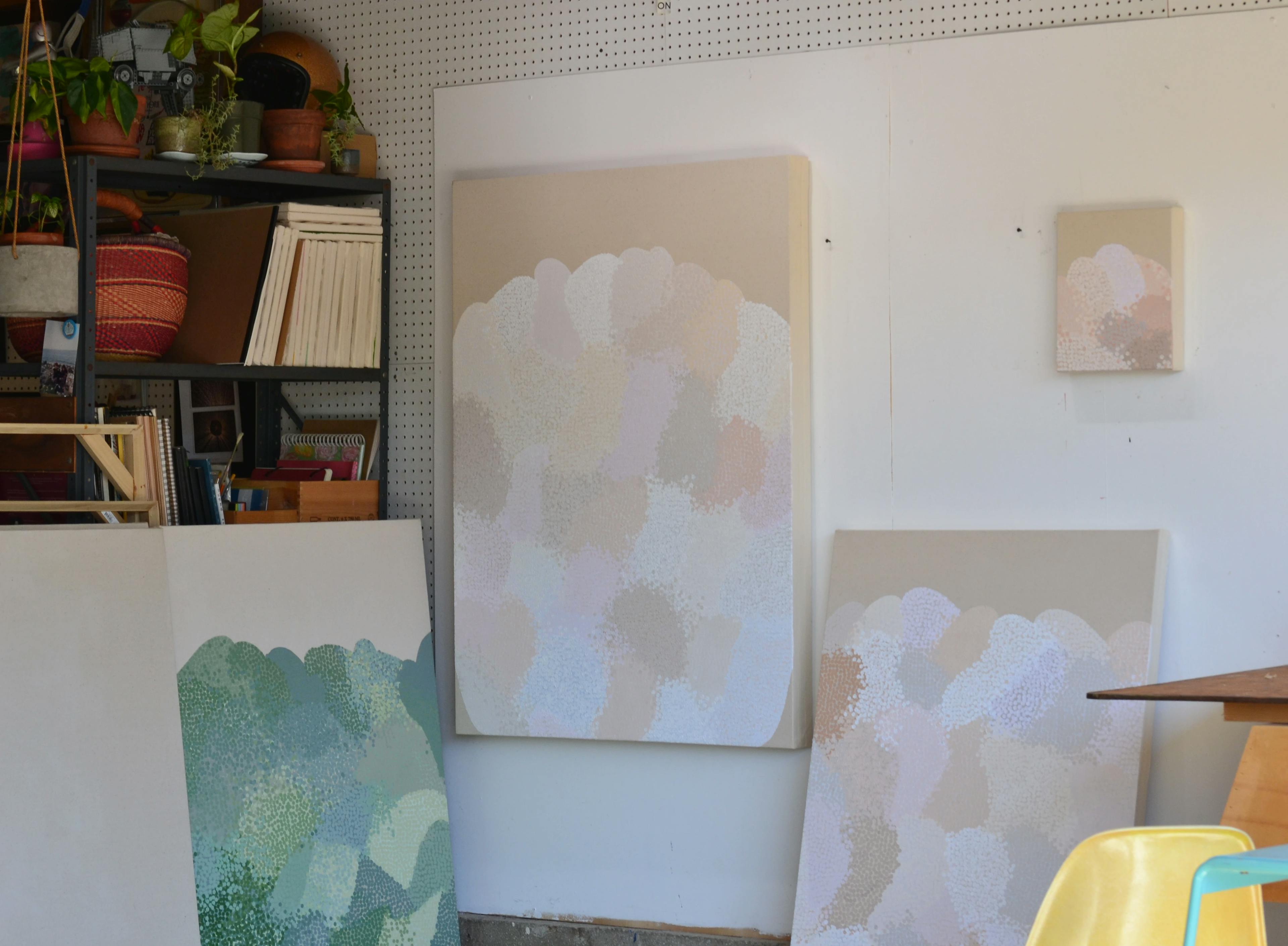
Ahead of his second solo exhibition with the gallery, Dan Covert trades perfectionism for play and dives deeper into the crossover between painting and sculpture. Take a look inside his studio here and read our conversation below.
Uprise Art: Who are you?
Dan Covert: My name is Dan Covert, and I’m an artist and director based in Brooklyn.
UA: When did you start developing this body of work?
DC: I’ve been making art for a long time, but this body of work has been developing for about a year to a year and a half. It happened slowly. I’m not just working on one body of work at a time. There’s a lot that has to percolate. I always have work at the fabricator, in the studio, at the gallery. Things hang in the room, I change them, think they’re done, then I morph them, come back to them. It’s an ongoing, organic process.

UA: How would you say your work has evolved over the years?
DC: I think the work is evolving a lot. I used to focus on complexity and perfection. Then it became about simplicity, boldness, and iconography. Now it’s more about the handmade.
The biggest development is that I used to make a drawing, bring it into the computer, fabricate it, and that was the end. Now that’s where the piece begins. I’m adding all these layers, I’m rounding things, I’m adding texture, adding gestural elements with molding paste, I’m cutting into stuff, I’m adding on top of it. So that's kind of a nice evolution of just being like, I have a plan, I start to execute the plan, and then I move it and evolve it just based on feeling and intuition. And the feeling and intuition part is very new because before it was more about execution and delivery of an idea. Now it is about a dialogue with a piece as it's evolving.
Since I’ve been working on this body of work over a longer period, there are different representations of how it’s evolved. Some pieces are more minimal, and about craft and perfection and precision. Others are more maximal and intense, so in that sense, there’s a pretty broad range. In the show, I have a body of work that are paintings that hang on the wall that are very sculptural, and then I have freestanding sculptures as well. Some are more gestural, some more iconic.
The paintings are definitely becoming more like sculptures, and that’s exciting.
Dan Covert


UA: Was there a specific change that prompted this more improvised and process-based direction?
DC: I think it’s just about trusting intuition more. It’s something I deal with in my career as a director, too. You think they’re separate paths, but they’re not - I’m dealing with the same stuff in both of them. I’m batting up against myself - my rigidness, my desire to plan things, my want to control.
As I’ve perfected my craft, so much control can start to suffocate the work. So now it’s about what needs to be controlled and what can be let go.
Dan Covert
UA: What makes your work still recognizable?
DC: I’m still dealing with very decisive graphic forms. That’s always going to be present in my work; that’s the formal language. Early on, I used a lot of shapes, almost like patterns. Then I stripped things down to create more iconic forms. Now I’m reintroducing complexity. It’s about how forms interact, how they balance, contrast, or conflict.
Within the graphic forms, there is so much room to explore, I never feel like I need to sit down and ask myself what I’m going to make. I understand the world I operate in, and then it’s time to play.
Dan Covert

UA: Do you think about the specificity of material in your work?
DC: I think material to me is more about something to learn and play with. It's not like Donald Judd, where I'm using these mass-produced things in an intentional way, or like how Mark Bradford does all his stuff with materials he finds at Home Depot.

UA: So you're not trying to draw attention to the material for the material itself?
DC: The material is not representative of anything other than something for me to experiment with and try things with. I like to jump around a lot. I kind of get bored. I'm both a creature of extreme habit and someone who likes to shake it up a lot.
UA: Why did you get into sculpture?
DC: I got into sculpture because I had a friend say, “Your work is very sculptural,” even though at the time it was like black marks on a white piece of paper. It got me thinking. Maybe sculpture could be a way to simplify my work. At that point in time, in the work I was making, there were a lot of shapes that were interacting almost like a pattern. So I thought, ‘Could I be confident in the work enough to make a singular form that held together as a sculpture?’ And that was a leap because I had to believe in this enough that I was going to invest in whatever the material costs were, or pay to get it fabricated.
And even then, sometimes it's a failure - but I’m continually refining.

UA: What is the process of translating your sketches into sculptures? How can you tell what will work as a sculpture or maybe what’s better as a painting?
DC: It's hard to tell. With the way I draw, what's gonna look good from 2D into 3D isn’t so clear. With my earlier work, I would just take a drawing and use the computer to extrude it out in Z-space and that would be the sculpture. Now I draw it, and cut it, and extrude it, or pour it, and then round stuff or cut into stuff..it changes a lot from the drawing to the sculpture. Then I have to think about how the sculpture sits in front of you, how it looks good from 360 degrees. It's just a different concern, you know?
UA: Do you feel like you’re bridging these formal structures with an abstract expressionist gesture?
DC: The work that I always come back to are those AbEx painters. In the last few years, I’ve been really studying the work. In particular, I’ve enjoyed reading, Ninth Street Women, which focuses on five women from that movement. Before, I would just look at work and be inspired visually by it, and now I'm reading more about how those artists lived and the concerns that they were trying to deal with in the work. Whether that's present in my own work or not, it's just like another layer of academic rigor in terms of studying their careers that I keep coming back to over and over again.
Abstract Expressionism is primal. It feels like it was made by hand. A lot of that work is representational to those artists and based on memory or experience. My work is not that, but I’m drawn to that energy. They spent a lot of time honing and finding different ways of experimenting, mark-making, and using materiality to have their expression be their own.

UA: Do you feel like you’re trying to find a defining gesture in your work?
DC: I don't think it's a gesture as much as the forms. The forms are the thing that I build on top of, and then it's a problem that I need to solve. One of the pieces may be more gestural, or one may be more linear, or one may be additive, or one may be subtractive. I’m asking how does the form, how does the color, how does the mark-making all fit together? I'll investigate something and maybe do a couple of pieces in that world, and then the next one will be totally different and a reaction against that. I'm not over and over again trying to repeat the same style. The way I used to work, I’d say to myself ‘I'm gonna make sixteen pieces like this,’ and now I'm like, it's fine if there's only a few or only one. I'm more rapid prototyping, and rapid experimenting, where I think the control thing that we were talking about earlier, I would really get locked into a language and want to investigate it all at the same time, and then move on. But now things are a little bit more porous and kind of flowing and fluid.
UA: What would you say makes your work feel like yours?
DC: The cheap answer is it feels like me because I made it. I had a friend ask me at one point, “Are you ever going to make a painting that feels different than the other paintings?” And you could certainly look at my work and be like, ‘oh, it's all kind of the same.’ But you could also look at it and be like, ‘it's wildly different’. And if you looked at my work from ten, twelve, thirteen, fourteen years ago and looked at it now - it's a different person. But there is a through line in the work.
I like evolution to happen in a stream. I want it to all flow. Even if I am taking risks and trying sculpture or trying things that are more gestural, I want it to feel like it's from the same world. That is important to me. I don't want something to get lost in my searching. I want the searching to be additive.
Dan Covert
I saw this Keith Haring show probably fifteen years ago at the Brooklyn Museum, and in it he had this sketchbook of like three hundred forms. It was like his language, and for him, having those forms as a key to go back to was about painting being a form of dance or a form of movement, a form of subconscious. Well, my painting isn't that. I also have a language that I work in, that’s always my starting point so I take the idea of the blank page out of it. I don't want to sit there and be like, ‘what am I going to make’? Because to me, that's like the most boring waste of time ever. Instead I want to ask how I can evolve. That's much more interesting than me. I'm just not interested in representational work, and I never have been. It's not where my aesthetic strengths lie. I mean, I own a bunch of representational work, and I'm drawn to it. I collect it, but it's just not ever been of interest to me in my practice. Operating in the language of abstraction, it's based on a series of familiar forms to me. It’s a way to free myself up to make anything I want.

UA: What do you make work about?
DC: Ultimately, the work is all about me and the concerns that I have in my present-day life. Because a lot of my training was about communicating a conceptual framework within advertising, inherently from the beginning when I started painting, I was like, I'm going to take ideas out of it. This is just form. But you can't just make form as an artist. It goes through my hand. So even if I'm trying to make form, my identity, what I'm concerned about in life, comes out in the work. So that was an interesting realization. And then now it's also an interesting challenge. As I evolve as a human, as I grow, as I age, as I get better as an artist, as I get more confident, the work can then explore. What I'm exploring in my own personal life. I am interested in emotion. I'm not interested in figuration. So I don't want someone to be like, “It looks like a horse”. That's so uninteresting to me. But the capacity for art to make people feel and for it to make me feel, I mean, it's probably other people's art that has made me feel more than anything in life. Whether it's a film or a painting, I get caught up in that. So while I'm not making a painting with the goal of someone feeling something specific, there are feelings involved. And more and more, that's what interests me.

UA: What's currently driving your practice?
DC: I think what is driving me right at this moment is asking how I can continue to make stuff that feels more handmade. How can things feel more alive? And I can go too far. I have to take stuff off, you know, paint stuff over - put too many marks on. Realize that all the marks are at the same scale, not have foreground, mid-ground, background and need to change that. Love a piece one day, hate it the next. It's this tightrope walk now where before there was this comfort level of just start and finish. Now it's this elaborate organic process where there's a dialogue with the piece, and that's really new - and that's exciting - but just a different way to paint.
UA: What tensions feel the most alive in your work right now?
DC: I think the tension is between things that are more minimalist and things that are more maximalist, and understanding that they each have a power to them. Just because you can make a mark doesn't mean you always need to. There was a tendency for me to look at the simpler work and think it was boring as I started to make more gestural work. But it's fun to go back and forth.
My studio is only 12’x12’ and there's like fifteen fairly large paintings in here. It's both maddening and inspiring at the same time. There was a piece that I thought was done, and it had been sitting here for a year, but then we had the group crit here with some fellow Uprise Art artists, and everyone was excited about another piece. So after everyone left, I asked myself, ‘okay, how can I take what's happening in that one and bring it into this one? How can I make the painting not feel like a background? How can I make the painting feel like this layered experience?’

UA: What artists, thinkers, or cultural references have shaped how you see your work or given you inspiration?
DC: I’m obviously super drawn to the Abstract Expressionists like Willem de Kooning and Lee Krasner. Jean Arp, Isamu Noguchi, and Eddie Martinez are also big influences. I mean, there's like, there's so many, you know what I mean? I have books and books and books.
I look at a lot of art. Like a lot of art. I go to auctions. I look at art online. I buy art. I'm surrounded by art. I live with art. I buy friends' art. I buy art that inspires me. You see paintings differently when you live with them.
UA: Are there people or things outside of the art world that give you inspiration?
DC: I go back and forth between film and visual art. Things ping pong back and forth between each other - the things I'm inspired by in the film world find their way into art.
UA: Did you have directors or films that have influenced your fine art practice?
DC: Yeah, Mike Mills is one for sure. There's just a simplicity to his emotional exploration that seems on the surface really easy - but it's not. And I think Spike Jonze is always huge in the sense of just a childlike wonderment and play. He reminds me that it doesn't have to be that serious, you know? The perfectionism of David Fincher is also inspiring in a very kind of controlling, awesome way.

UA: How do you think about balancing your fine art practice with your directorial one?
DC: Making art is most of the time a very solitary act and directing is a social act, so inherently there's a conflict between them. But it's fun to not leave your house for a long time, and then it's fun to go out in the world and bop around and mix it up and chop it up and talk to people and hang out. I like having that counterbalance.
UA: Are there personal narratives that tend to surface in your practice, even unintentionally?
DC: The stuff I think that I always fight against is control and perfectionism. There's a good side of that, and there's a bad side of that. So, how do I use that level of commitment to a piece in a way that isn't suffocating? How do I embrace tools and techniques that limit my ability to perfect something? Even working with Abbey, who's my studio assistant, that question still exists. She's using certain techniques, and I'm using certain techniques, and she has her strengths, and I have mine - those are always in dialogue with each other.
UA: What kind of conversations do you hope your work enters into?
DC: I don't try to analyze it too much. I think my job is just to make it, to talk about the things that are going on with me, and then people can decide what they do or don't like about it. I'm not trying to instill a certain dialogue. My art isn't necessarily like that. I mean, it's impossible to live in the world and not have any of the shit that's happening affect you, but... I don't think it's ever like a one-to-one of like, ‘this thing happened in the world, so I made this’. My practice is never really like that. I think it's more like ‘this thing is happening inside of me’, or ‘I am evolving’, then the work is evolving. It's more on its own island. It exists in the world, but it's not in reaction to it.


UA: What direction are you excited to explore next?
DC: I've been doing a lot of subtractive sculpture. There's a block of wood. I have tools. I carve it. But I’ve also just started pouring a bunch of concrete and plaster. I've done that in the past, but I'm coming back to it in just a slightly different way. Concrete instead of plaster, and instead of a straight extrusion from the mold, I'm starting to round certain edges, paint on top of stuff, cut into it, using pouring as a base rather than carving as a base.
I’m also thinking about how the sculptures can get massive. How do the paintings get bigger? Can they also get smaller? Playing around a lot with scale.
UA: Do you see yourself exploring new mediums?
DC: No, I feel like painting and sculpture could be a lifetime.